That’s right. No hour count required. The playing of January 2026’s Vital Shell had me thinking about my relationships to other survivors-likes and roguelites I’ve participated in, and the big glowing difference between others and this game is time gatekeeping.
Thinking back to Vampire Survivors original release, I remember folks raving about how many hours they easily logged into the game and the addictive loop of how fun it was to play the fresh idea. In particular, I remember listening to an episode of The Besties podcast and my favorite of the then 4, now 3, hosts, Chris Plante, exposed something really important that made me see the game completely differently – and at the time I didn’t want to admit he was right..
He said to his colleagues, all of which had, from the sounds of their conversation, played nearly 100 hours of the game, that he wishes that the devs would give you the game from the start, and let you be skilled at it if you would be. Said that the progression is on rails, and that you weren’t really allowed to be good at the game, but instead just had to put in the time. And knowing that, it takes the excitement out of those initial runs knowing you’re just doomed to fail. That the game won’t let you start ‘beating’ it until you put in the hours and obtain the proper unlocks. He said it’s too automatic in that way, and not very respectful to the player. The player gets very little agency, and all we are doing then is mindlessly plugging time into a pretty mundane activity of just moving around, avoiding enemies while our character auto-attacks. That didn’t stop me from playing over 100 hours of Vampire Survivors, but it certainly help me see the game this way, and maybe value my time in games like it less.
At the time, his colleagues and myself (me, mentally on their team while listening to the episode) argued that all games are kindof set up in that way. They’re predetermined. And that’s a bigger counterargument than I want to put into words here, but there’s the other side of the coin.
Point is, now, I do very much look to how or if games respect your time, especially in an era of gaming when they are thousands of options to try, and curious minds don’t want to be shackled to one experience for a long period of time. We can’t afford it! As time is now a big currency in the video game consumption conversation. I see Chris’s point and use it to view through a lens of what games are asking of you, and if they’re worth the time.
Vital Shell, a game that fits right into the survivors-like genre, in Chris’s words, ‘Gives you the game right away.’ And it’s great.
Vital Shell, specifically
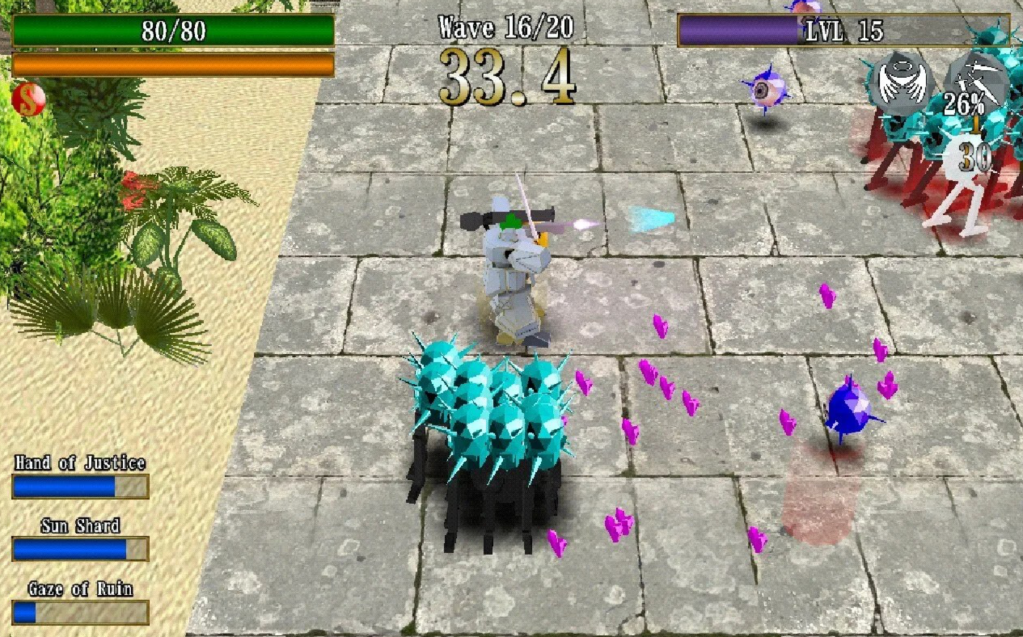
Vital Shell is a arena-based survivors-like with a PS1 aesthetic. You play as a mech that auto-shoots but also offers manual 360-degree aiming – auto-aim is the default, and you jump in with manual aiming whenever you feel like it. Rad. Enemies spawn in with a little, red, hollow light-cylinder warning. Action takes place in a fairly small arena and you look to survive waves that last anywhere from 30 seconds to just over a minute (if I remember correctly). Purple shard currency litters the ground as you eliminate enemies. Collecting it helps you level up and obtain upgrades. But if you miss collecting it during your round, no worries, everything you missed vaccuums to your character and you reap the benefits.
In-between each wave, of which there are 20 total in each level, you have your classic upgrade structure where you choose between 3 choices that will aid your survival. Those choices vary from attack speed, block chance, critical strike chance, armor, max health, life steal, etc. All very legible and understandable. And better yet, on the left of that menu screen rests an image of your mech with it’s stats in all categories. When you hover over a certain choice, it will show you the positive effect it will have in either number or percentage. Very clear, very direct. And periodically, throughout a round of 20, you get three additional weapons/attacks added to your mech to add fun variety and survival chance.
Mini-bosses arrive mid way and sometimes 3/4 of the way through dependent on the level. They are not required to be felled, but just offer an extra challenge in survival.
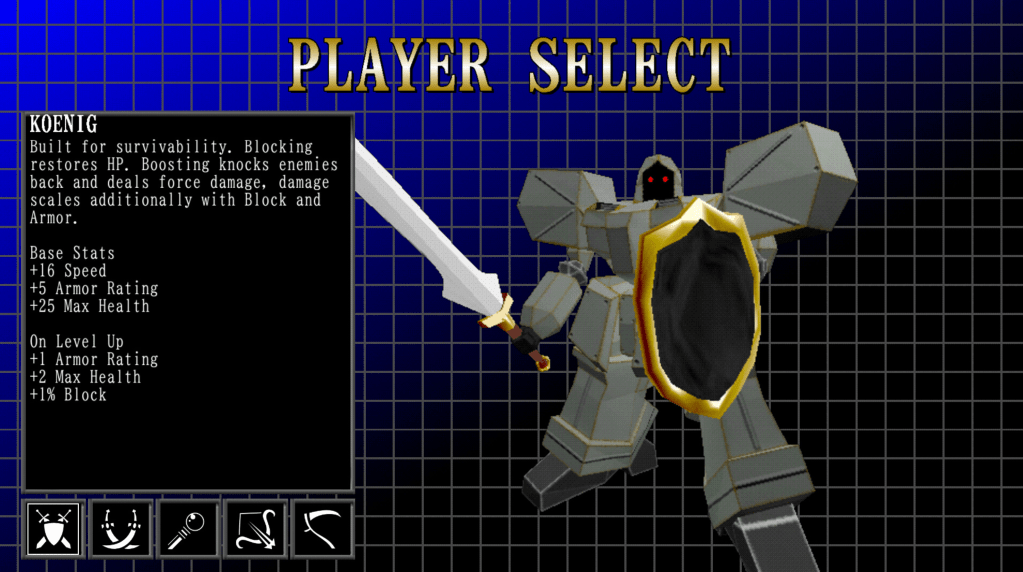
There are 5 total levels, all with boss fights on the 20th stage. 4 of the bosses are mechs you need to defeat and then are rewarded with unlocking them for use. And each mech, of course, transforms how you can see and play the game.
Back to my original point
I very quickly realized two things: (1) I very naturally clicked with this game and felt ‘good’ at it early. (2) The game lets you be good at it if you’re good at it – right away. Now, I’m no prodigy and I’m not saying this game is particularly difficult. But the experience was certainly not gatekept from me in any way. I blasted through the first two levels with success of balancing what I felt my mech needed at the end of each round, and with prior-knowledge of other survivors-likes. I then hit a brick wall on level 3 out of 5. Which was cool and interesting. The feedback of the game told me that I wasn’t understanding something, and that I needed to keep playing to figure out. Lesser games become frustrating in these moments, and one will then bounce off. Good games make you intrigued in these moments, and the ‘figuring out why or what to do’ is still extremely fun. That’s the bread and butter, and Vital Shell keeps it interesting without making it too grindy. And it doesn’t gatekeep success if you haven’t put in a certain hour count. The game lets you earn through skill if you have it.
A the end of level 3, this fella was my nemesis for more than a few rounds:
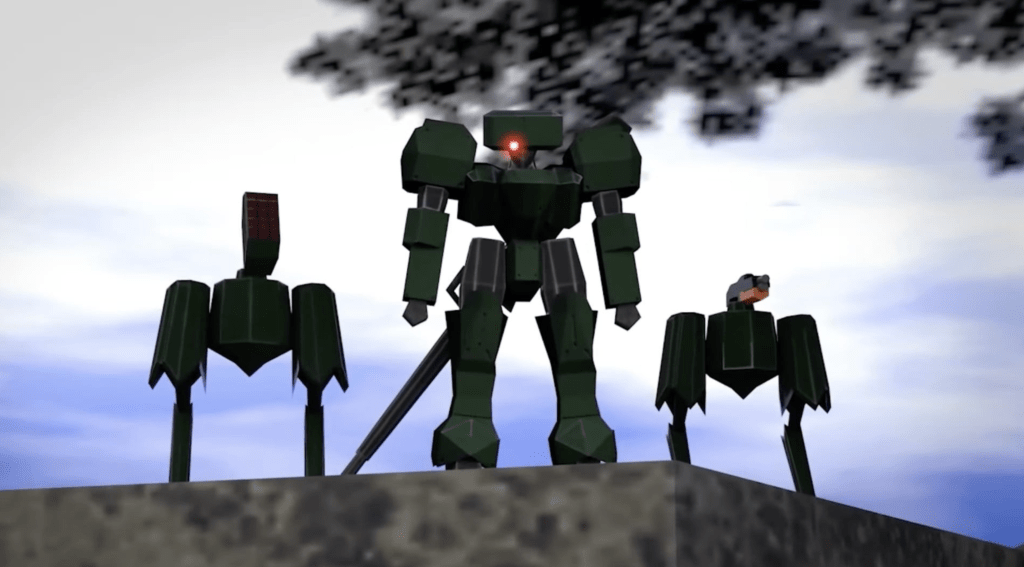
Each time you reached round 20, you were gifted the very PS1 style movie that theatrically introduces the boss mech you’re about to face. The first few times falling to this foe, I think I had been used to the near-automatic flow and success I’d had with the first two levels and thought doing whatever would be enough. But I’d get to this boss fight and would find my health bar quickly hitting zero. So I tried a couple rounds with some heavy attack builds, recognizing that level 3 was a bit more congested than the first two. But with that approach, I found I was then too weak at the boss fight. Then I switched up the mech I used for a couple rounds to the same failed success. And I’m not sure what type of gamers y’all are. But for me, especially in roguelites, I don’t find myself eager to jump right back in to another 20 rounds after failing at the end. Especially if I had the boss down to a penny of health left. What eventually worked for me was a very tanky build with lots of armor and health regen. That, and patient survival, chip away at the boss slowly but surely. The cool part about this game is that many things, and all the things offered, can work in certain combinations and it gives the player fun builds to mess around with. Different ways to play the same game.
Something I really want to emphasize here is that in-between each round when you make your choices, although their marked by teens of percentages, you actually feel them. I often roll my eyes when an upgrade in a game says something like, ‘crit chance increased by 8%’ and you know you need multiple of those to even notice a difference. But the increments in which you adjust your mechs performance round after round are felt and it makes the choices in-between meaningful. Makes for a great balancing act in which the way your mech performs is direct feedback to the tinkering you need to do in between. When you feel better, and it feels worth it, the game then is properly rewarding you all while never making you completely overpowered. In no moments of Vital Shell was I hands off the controller watching my mech automatically eliminate everything. If you played deep enough in last year’s Ball x Pit, you know that a late-game character unlock winks at that very idea 😉
Other great features and final notes on the is that the music absolutely rules. Fits into a Neon White adjacent playlist – calm electronic but with very fast percussion. Internet core? Call it what you want, it was great accompaniment to the vibe and energy of play. There’s an ‘Official Player’s Guide’ in the menu that doubles as almost a digital game book that has information about all the weapons and upgrades in the game. Just nerdy cool stuff and a nice additional detail. And lastly, when you beat the game, you unlock an arcade horde mode in which you can compete in weekly challenges to try to get yourself onto an online leaderboard. I won’t be competing, but I think that’s a really great post-game option.
Vital Shell easily landed itself on my 2026 GOTY list. A compact survivors-like experience that’s all there from the start and doesn’t overstay it’s welcome. More games of this size and quality please.
Thank you for reading,
Your Friend Dillon
 Your Friend Who Likes Games
Leave a comment