
I think this game will make me a better person. The empathy shown between characters makes me question my ‘I’m not your therapist’ attitude toward my own friends (while still practing proper boundaries). Very real characters navigate life’s challenges and aid each other through intentional listening. The community found over quality drinks continues to flourish in this world, and I welcome continued iterations of the series.
After the discovery of what the first Coffee Talk was years ago, and an admittedly-rushed playthrough of the second, I certainly welcomed whatever Coffee Talk Tokyo wanted to be. And I myself, and I think others that have played, have enjoyed the fact that it doesn’t stray too far. The game of course incorporates lore and culture of the location, but its roots in deeper, empathetic conversation, community building, and stylish pixel art stay true. Even the classic bell-on-the-door sound to indicate chacter entrance and exit remains to tie the franchise together.
I felt I was a better barista this time around, or at least I wanted to be. I cheated when I didn’t know a recipe, but I also didn’t know in playing the first two games that getting the drink wrong can affect dialogue and outcomes of your playthrough. That, and the drinks look far better when properly executed to what the customer actually wants to drink. You can tell when you make something ‘incorrectly.’ When you make a drink proper, it has its own unique name and the pixel art presented is really special. When you make a drink incorrectly, the name is simply a list of ingredients you put into it and the drink appears boring. The drink name becomes reminiscent of a dish created on Top Chef. ‘I have for you an iced ginger soymilk chocolate’ opposed to the proper drink and presentation in the fully-titled Chaiced Cocoa (see below). There’s still that fun anticipation build-up when your barista is brewing (still shown through classic 3-picture ingredient prep and appropriate sound) and hopes that you’ll be shown the fun and beautiful pixel art when the drink was done right. But it’s cool too, the realness in-game that customers will just ask for and order what they want. And in the midst of all the fancy drinks, some customers would just like a simple tea or espresso based on mood. I appreciate that coffee shop human-ness and authenticity.
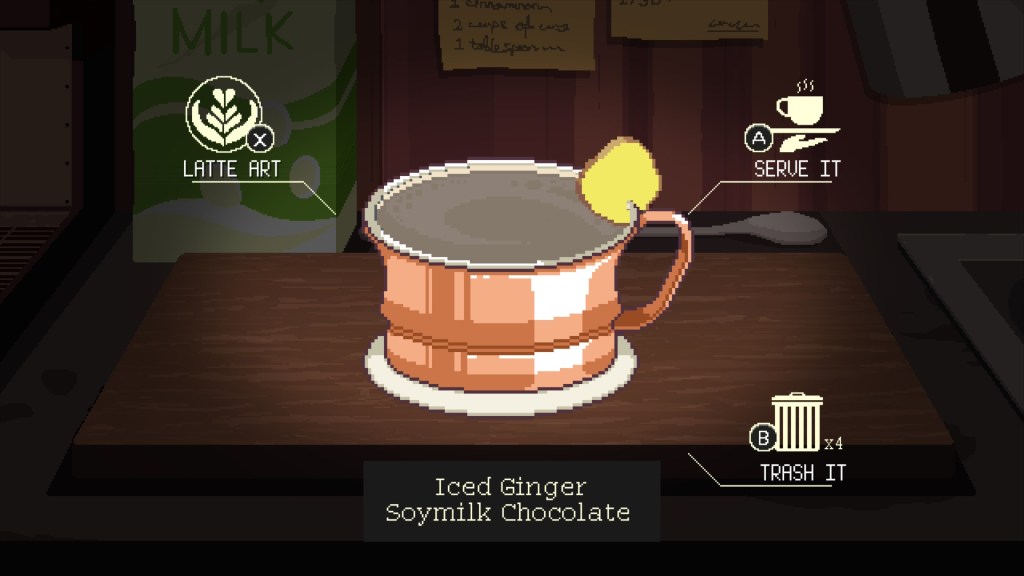
vs.
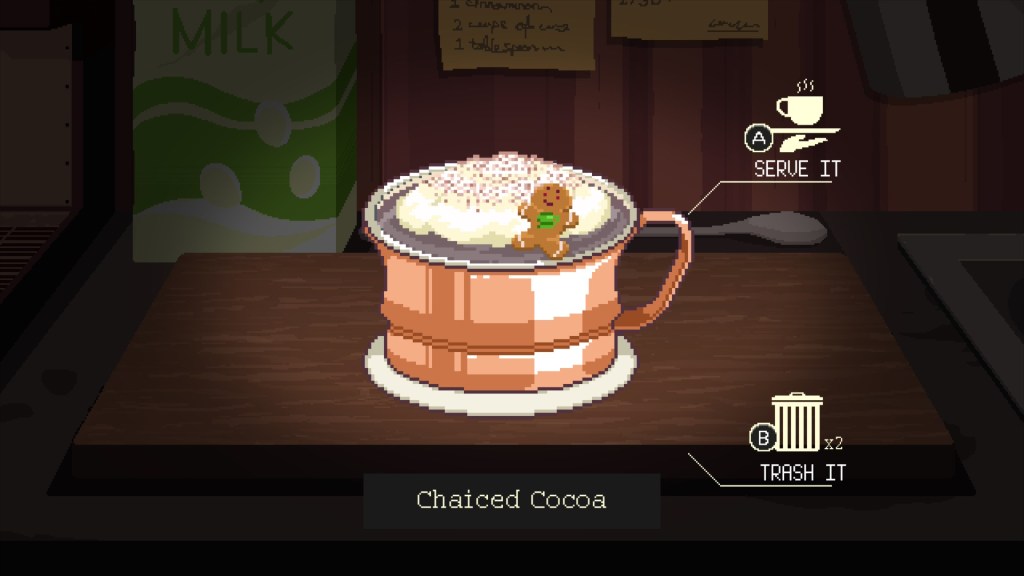
I came to realize in playing Coffee Talk Tokyo, again the third iteration of the series, that the Coffee Talk Cafe is one of my favorite places to be. The familiarity is very comforting and the games have an unmatched style and vibe. Forever accompanied by the vibey beats of Andrew Jeremy – this time with small hints of Tokyo without sounding too obvious or appropriated. I didn’t realize until I started playing how much I needed a revisit to one of my favorite foundational indie game series.
Check your notifications?
One aspect of the game I participated a bit more in this time around was the social media component. I was mindful of the things I ‘liked,’ paying attention to what was posted and who posted it, and curious if it did or does have any sort of affect on the outcomes of your playthrough. But what may have been more interesting with the social media aspect of the game was observing how I behaved with it. I felt rude if I was checking my phone while in the middle of a conversation with others. I tried to complete any social media checking before my shift started and when there was no one else around. At first, I made sure check my in-game phone each morning and be sure to click on each new post or hashtag so that the notification would go away. I quickly realized this became akin to checking and deleting emails, which is something I try not to waste my time with in real life and therefore let the notifications pile up in-game. As expexcted, I eventually stopped caring about it all-together and found greater value in the in-person connections. I feel that way in real life too, and am going to pretend for myself that the game pointed me in that direction. By including social media into the game, it automatically asks the player what they want their relationship to it to be. I think some could really enjoy the deeper layer of character found in what some people choose to post in relation to how you know them in the context of your coffee shop. The game captures beautifully how modern people both project and communicate online. It was interesting for me to see the people I knew, how I knew them vs. how they behaved online. Funny too, how characters of different generations behaved online. One of note being an older gentleman asking for grace as he learns how to use the online app, and signing off his post like a letter with a ‘sincerly, [name].’ Oh, and I welcome the chuckle found in parodies of contemporary memes. I’ll let you discover those yourself. XD
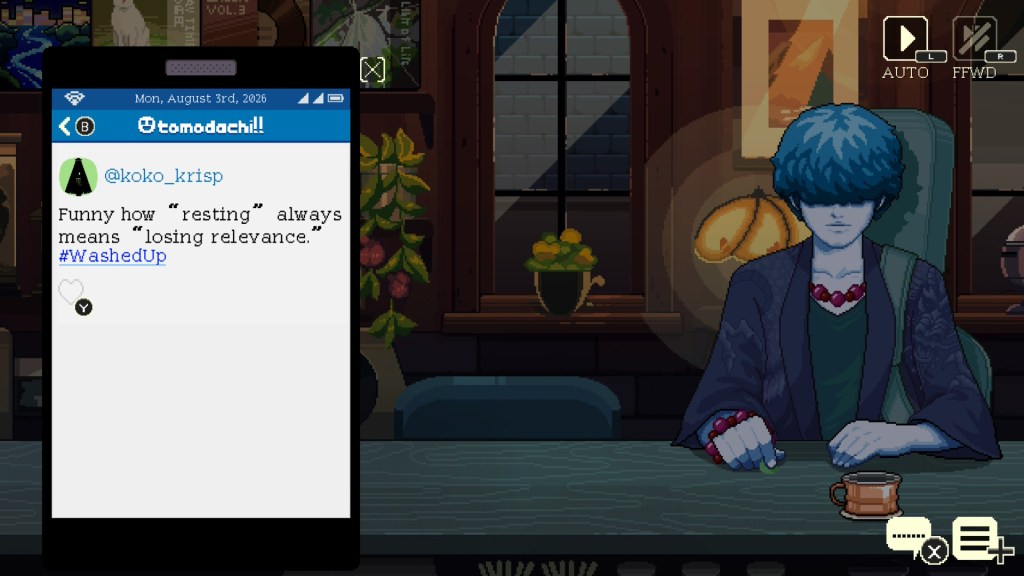
One of a few favorites that I snapped rests in this post above. This example, and many others found in the game, make me thankful for and it make it very clear that everything placed in game is very intentional and can have interpretive commentary. I love this one in particular because it hits home with what some of you know I have been struggling with. I’d been so afraid to end the podcast. So afraid to lose relevancy and connection. And frankly, I have. But the cost of keeping any of that connection online has been way too high and has required more work than I can afford. I’m happy to report that I’m settling into games more now. I’m savoring them. Enjoying them. The character Jun in this game offers a great story about creative burnout in relation to the work one does and the audience that receives it. The arch being the search for what is best for the person who is making. And while I’ll let you all explore that if/when you’ve played the game, I will conclude that this blog format fits best for the pace in which I’d like to consume games, and is better for me – regardless of whether or not it is used, popular, or relevant.
Empathy
The writing alongside the pixel art is what shines the most in the Coffee Talk franchise. And Coffee Talk Tokyo brings the empathy. Note, I don’t intend to spoil specifics here, but would like to celebrate themes and concepts this game presents well within the topic of communication. First, this game has many wonderful scenarios of multi-generational communication. A recently retired old man tries to lecture a Gen Z’er. Adults respect a child as a fellow human. A character assumes they know a celebrity just because they follow them online. Others help one-another through various grieving processes. A young person over-works and doesn’t know how to ask for help. And you, the barista and host, as always in the series, roll-play as the facilitator and the glue. The Coffee Talk Cafe is a place that people can come to unwind, but also have very honest and real conversation. Conversation where people aren’t just waiting their turn to talk about themselves, but are asking about each other and are there to help each other through life’s difficulties regardless of their differences. Now, that’s not to say it’s sunshine and rainbows. Coffee Talk Tokyo features very real and human characters, and not all conversations had come without rumble. But better yet, the game shows through example some successful ways (and unsuccesful ways) to navigate those harder, sometimes-more-emotional conversations. And it uses the unsuccessful ways to share lessons to learn. An example that comes to mind is when a character tries to solve and fix opposed to listening. That concept was a big one I had to learn and grow through with my wife early in our relationship, and I’m happy to see a game show an example of how fixing can’t work. In addition, and in another game context, I caught a character asking another, “Would you like to vent? Or would you like my advice?” So it does both. Shows us how to not listen properly in trying to fix and solve, and other in which a character listens intently.
You – the barista, the host, and the glue
Some find the Coffee Talk series to be a bit boring and narrow in regards to play – to which if you’re looking for a gameplay heavy game, or a game that has more for you the player to do, I understand this criticism but also would say this game series is not what you’re looking for. The Coffee Talk series is almost exclusively a visual novel – one in which the only influence you the player may have on the outcome is whether or not your drinks are deemed successful based on what the customer ordered. But that being said, I really don’t mind and actually love role-playing as this barista. I named them after myself to feel the first-person attachment. But this person feels like a modern old-head. This barista values quality over quantity. This barista values individual and intimate group conversations, not getting as many people in and out of the door each day for profit. This barista makes drinks for ghosts so they can try to smell them – knowing for certain they cannot taste them. This barista only opens the coffee shop at night to invite a vibe that invites ‘after a long day’ conversation and venting. This barista stays in touch with local current events. They know and care about the lives of others by staying informed. One quality I strongly relate to is that this barista is tactful with their communication. They patiently wait for and/or use appropriate windows to say what is necessary in that moment – and its almost always in the form of a question that keeps the conversation alive, or advice that is warranted within the context of the conversation. They facilitate the coversations had in-shop with intention and empathy. Through these character qualities and the providing of excellent coffee, tea, milk and cocoa beverages, this barista creates community. Parts of me in real life can behave this way, but I have a lot I can learn from this barista and a lot I can take from this game.
Memorable poetry
Okay, this section might be semi-spoilery if you do not want to read exact snippets of what characters say. I’d like to share here some quotes of note from the game here to prove that even out of context, show where the strength of the game’s poetry lands in the concluding thoughts of the game’s conversations.
“As parents, all we can do is love them as much as we can while we can.”
“I almost spoke in the voice of someone else.”
“Nature has a lot of quiet wisdom.”
“You make all the worry in the world feel meaningless.”
(During Obon celebration) “The veil between the living and dead is thinner.”
And, of course, one of my favorites carried over from all the games, your barista often assures customers, “feel free to stay as long as you like.”
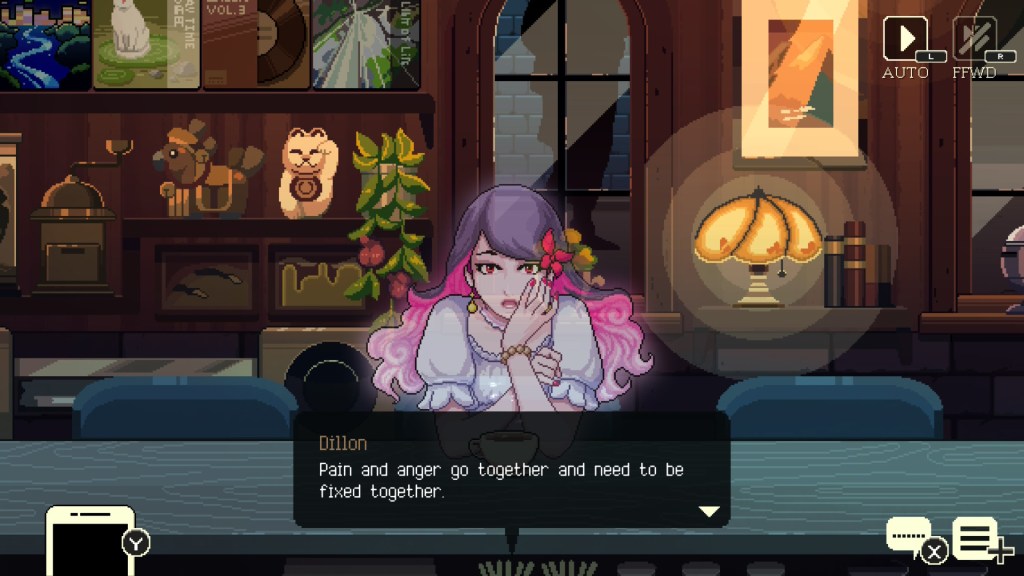
Simply put, the writing for the Coffee Talk series continues to be great. Additional good one in the pic below:
Leftovers
Some final notes here that don’t quite fit into a larger category. I’m thankful for the chill, one-line-at-a-time approach to this one as I was able to play one-handed holding my napping 3-month old. I enjoy that the Japanese culture is just within the game and not spelled out or overly educational about it – it just is and is sparking my further investigation of the mythology(?) of water dragons and kappas. I like that silhouetted bullet train greets you on the menu screen. I feel like this third iteration really foound its voice. I find it interesting that Coffee Talk games are set in the near future of the date they release (this one visits August 2026). Its moderately but appropriately long,and I am happy to report that I savored it. Lastly, you may already know and I learned this from the second game, that the progress bar indicates all game progress, including secrets and re-plays, multiple endings, etc. So when I rolled credits, that progress bar was only half-way full on my save file.
I think that’s it. This game is beautiful and is easily high up on my 2026 GOTY list.
Cheers, thank you for reading, and if you’ve played this one, let’s talk about it.
Find me on Instagram @yourfriendwholikesgames 🙂
Best,
Your Friend Dillon
 Your Friend Who Likes Games
Leave a comment