I don’t want it to die, this energy and momentum I have with the game. But I also don’t want to skip writing. Putting down a game, finishing a game, or ‘bouncing off’ a game is always a grieving process to some degree. I’d had this problem with the podcast, one in which I felt that if I said how I was feeling about a game, I’d give it away, and my playtime and discovery with it felt over. This writing is an attempt to get over that hump, and permit myself to keep playing after writing about/talking about early impressions/contexts of a game. My goal is to keep games special inside of me, but also allow for sharing and consistent writing in the process.
But also, at the time of writing, the repetition of Tomodachi Life: Living the Dream‘s structure has me burnt out to the point that I am ready to move on to something else – *for now*. But I don’t want this last impression of the game to be how I remember it. I’d like to get better at simply recognizing that I need a break from a game without labeling how I am ‘completely done’ with the experience. Relationships with videogames are more complicated than that.
So my additional goal is to let myself play games in sections, and recognize that taking a break after 25 hours doesn’t mean the experience is completely over. This writing aims to strengthen my playing & writing relationship, as I want to keep both steady, natural, and honest. I’m starting to discover that a big part of burnout in regards to video game consumption is that we don’t often allow our brains time to process our gaming experiences as we consume, consume, consume. So the following writing is an attempt both celebrate what I have enjoyed in Tomodachi Life: Living the Dream and also stay critical as to why I’m naturally desiring a break from it. Let’s get into it.
We can thank my sister 🙂
I’d been a bit hesitant to pick this game up. The demo felt underwhelming, and I think at the time of release, I will still overwhelmed as I pecked at the massive game that is Pokemon Pokopia. I wasn’t ready then for another big/long-play game. But Summer rolled around, and being an educator, I get Summer’s off (be jealous, but they’re well-earned thank you), so the idea of a longer-play, check-in often style game then seemed more fitting. That, and my sister reached out and told me that she picked up the game and was having a ton of fun with it. Lauren, if you’re reading, thanks again for selling this one 🙂 Safe to say that the full game has a lot more to do than the demo does.
I love the game. It’s “weird Nintendo,” as Into the Aether‘s Brendon Bigley states. It looks and sounds oddly fake and robotic, but it’s a game that’s so deeply human. It’s a game about human behavior, both individually and socially. It makes fun of itself, it knows its weird and owns it.
One thing I recognized early is that everyone’s playthough gets to be unique to their headcanon. My sister sent me pics of her created characters from Demon Slayer, featuring an impressive rendering of Nezuko. It clicked in my head then, that my playthrough of Tomodachi Life: Living the Dream gets to be entirely mine. The way people engage in this game is through an expression of their own culture. We input what we find funny, cool, interesting, and play with the idea of all of our favorite and created characters coming together to live in one place in a very reality tv show structure.
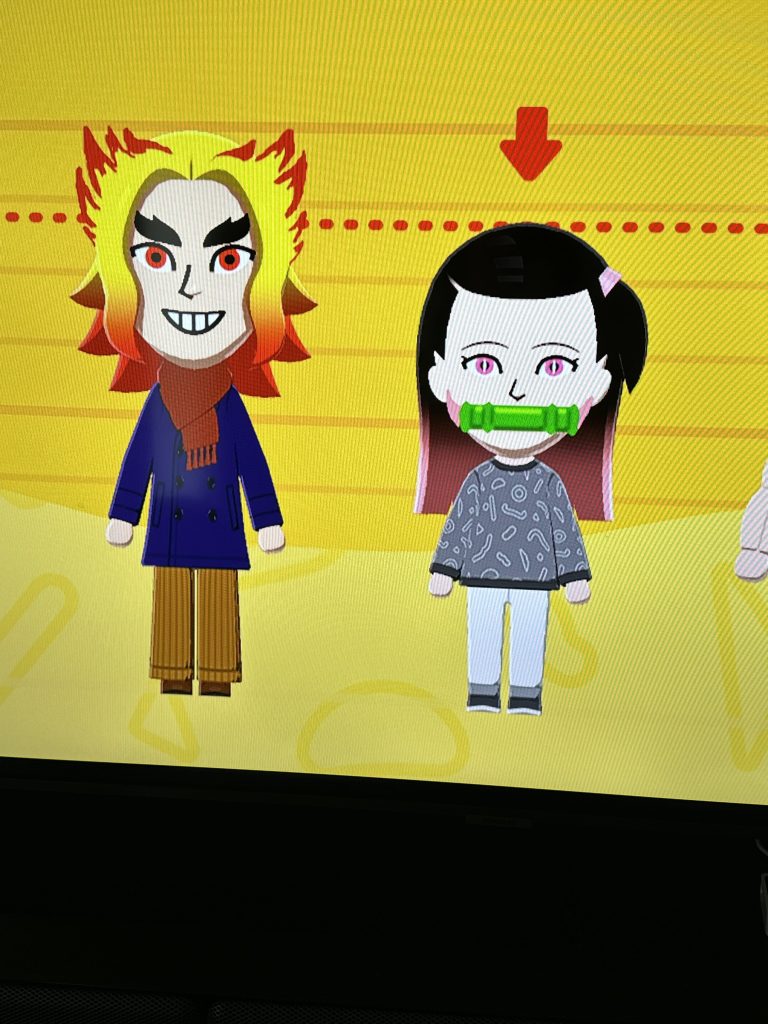
As I began making characters from various shows/cultural references that I felt would translate into legible Mii’s, it was fun to not only create them visually (amazing variety in customization options), but to look up start dates of their shows/games and make that date their birthdays, or think hard whether or not their personalities lean all the way quirky, or perhaps one tick closer to normal. And its been serendipitous how when you attempt an authentic input of qualities, you get out a character that behaves fairly closely to the character you intended. However, the game knows this too, the comedy comes from times when a certain type of character does something you don’t expect.
Quality of (island) life
A big difference I was happy to see from demo to real game was that the full game keeps moving. The pacing continually has happenings that encourage you to engage with your Miis. You continue to unlock new buildings, features and items to add to your island at a quick pace. And you can customize and create up 75 Miis to live on your island. Once you create a certain amount of Miis (I forget, a number under 10 I believe), the floodgates open and the game tells you that you can now make as many as you want. I’ve made it to about 23.
One thing that stands out to me in Tomodachi Life: Living the Dream in the context of decoration and in comparison to games like Pokemon Pokopia and Animal Crossing: New Horizons, is the streamlined island decorating that one of your Mii’s can suggest. Instead of the decorating decisions being exclusively on you, a Mii can have an orange(?) thought bubble prompt that when clicked on can lead them prompting a bit of critique of how their island life would be better if more pathways were placed to make it easier to get to their house. Or how the island is too dark at night and would look better if properly lit by streetlights. And the major difference in this game, again, is that it doesn’t just say words to critique the player and put pressure on them to create. Instead, the Mii says something like, ‘here’s what I had in mind…’ And in your top-down island view, the suggestion they are making is shown to you exactly the way it would look. You then flip back to talking to them and they’ll ask, ‘whattaya say? It would cost _____ amount of money to complete. Should we go for it?’ And every time, I’ve said yes. I’m sure there are other players that may look at that suggestion and think, ‘sure, but I’d like to do it my own way,’ and that’s cool! Admittedly, and maybe unfortunately, I’ve found myself less and less motivated to create and decorate in games like this. So the quick, ‘we’ll progress it for you for a low cost’ is very welcomed.
Same goes for placing various items around the island. Mii’s will say, ‘You know, I’d just love if there was a sprinkler in this area. It’d make my life on this island so much better.’ And who am I to say no? I guess just their god-like figure that prompts, places, and creates new life… But again, I think there may be two types of players. Some that enjoy more control and want things placed and decorated a certain way, and then there’s some like me – letting the game and Mii characters suggest the natural/programmed chaos to unfold. More of a witness than a god.
But in regards to efficiency, the UI is intuitive, it’s fast and snappy. They make it easy to find any resident you’re looking for. The whole island feels like a big menu – one that hosts the various residents’ houses and stores to click on in a organized fashion that you see fit. With the variety of characters to manage and talk to, I am happy the menus and clickability of it all is fast – it’d be pretty unmotivating if it wasn’t. That’s another noticable difference worth pointing out from demo to full game – I feel purchased game for Switch 2 runs a lot faster than the demo. I feel the demo was built to run on both 1 and 2? But the full game on Switch 2 lets it run faster? I’m not sure how that works or am not qualified to say so, but I can say that load times between outdoor and indoor are noticably faster.
Raw creativity
Other than Mii creation, of which I took my time to make characters look as accurate or iconic of a depiction as I could, the creativity in game feels fairly pressure free. It feels raw. I say so in the way that it feels like the nature of the game to make a quick joke. Most of the time you are doing so by mad-libbing words into contexts, and with the game’s fast communication pace, when prompted to make a cake, a record, or a home exterior, I felt like I did just enough visually to communicate the joke. For example, as long the album color was all black, had green font made of scribbly letters that read “The Monster Mash,” it was legible enough to when a character received it, the title could be read, and the joke was made. To me, with the ‘gee thanks’ quality of characters receiving gifts, I’m not motivated to make any item that looks extravagant. And I don’t believe the game wants you to stress over it either. The attitude feels like it encourages players to be loose and silly with their creativity, and not fret too much about what it looks like, but again, focus on more on what the item is saying. Afterall, this is a communication game.
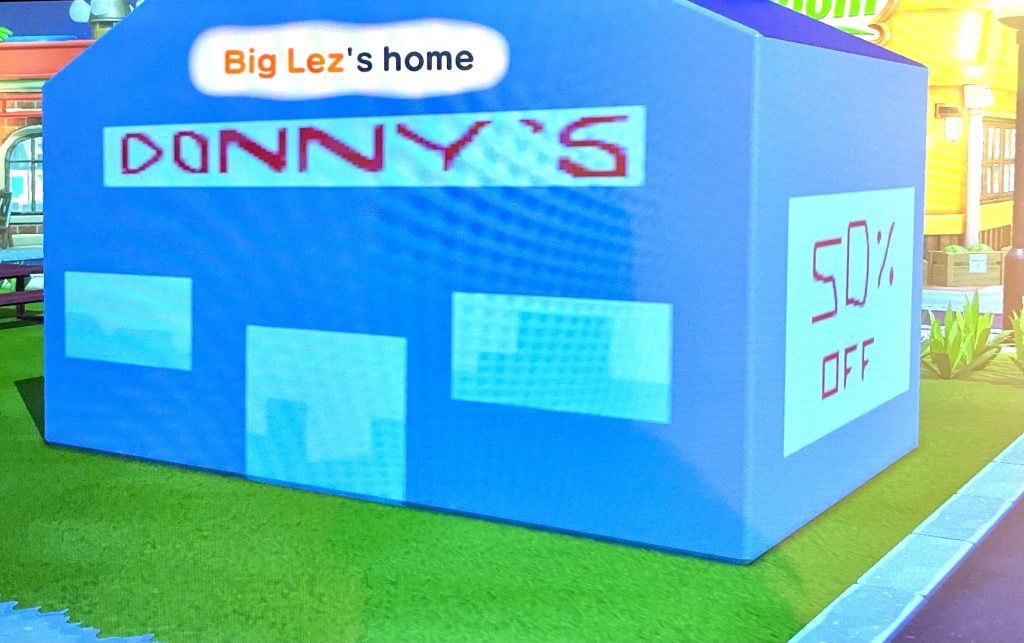
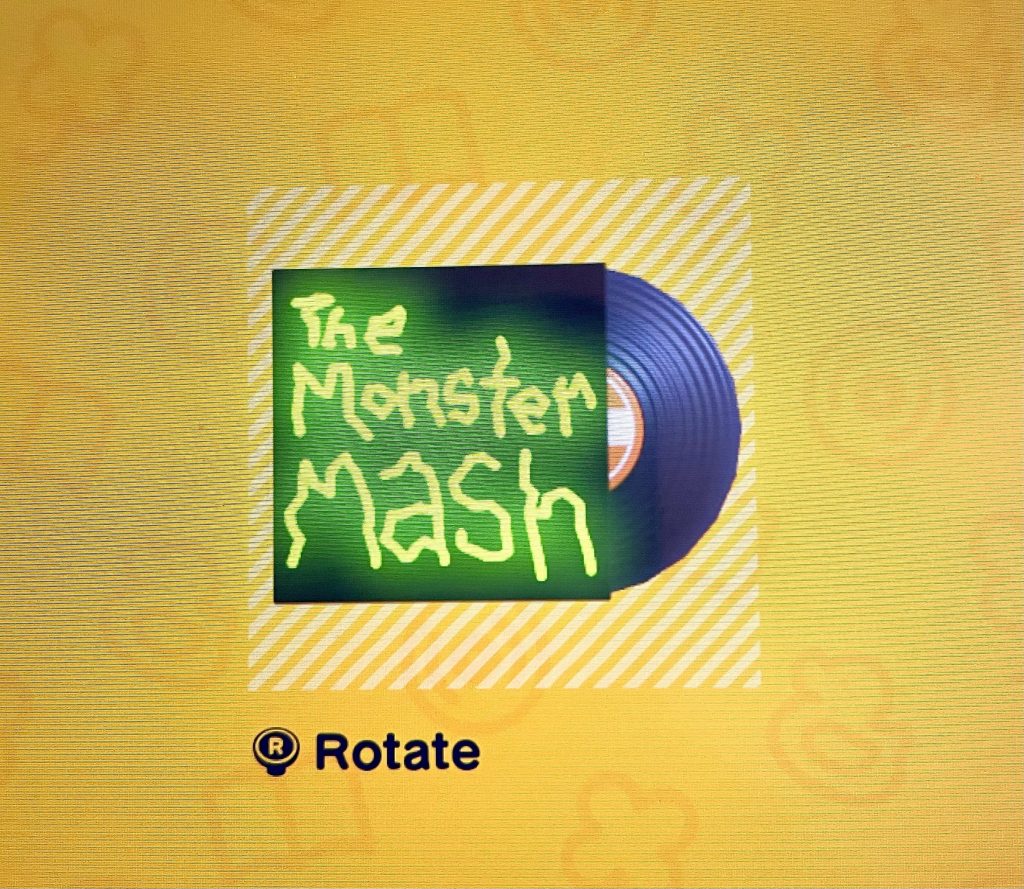
The encouragement of the game to be quickly and loosely creative had me reflective early about my relationship to playing it. Socially, even before its release, we knew this game was going to be meme-able. After release, it certainly was. Content creators all pushing the boundaries of censorship by seeing what they could get away with and posting reaction videos. Early in my playthrough, I felt like I was continually playing to make a joke. To trick the game into mad-libbing something I could screenshot and post or send to friends. But after my friends seemed to kindof but not really care, and my posts lacked any sort of real reaction, I realized I had been playing the game for everyone else, and needed to start playing the game for myself, not for a reaction. And I think that’s when Tomodachi Life: Living the Dream really clicked for me. When I stopped any sort of hesitation and let creativity flow naturally, that practice created moments that surprised me.
The more ‘stream-of-consciousness’ approach allowed moments where a little robot buddy I created and randomly named AG147 received the nickname of “Athletic Greens” from a friend. It’s not particularly funny, nor was a trying to make a joke, but hearing/reading “AG” told my brain AG1 a.k.a. Athletic Greens (no sponsorship here) and I went for it. It was a happening made completely for me, with no social reception or sharing intended. I’ll admit that I didn’t approach every play session with this much freedom, but had the most fun when I did. That’s a bigger conversation I could have regarding my relationship to games and writing about them.. I’m trying to play less as a means to an end, or getting through games just to have something to say, and more toward really enjoying the playing and try to reflect on it later. Complicated. All that being said, Tomodachi Life is a game that gives you more variety with the amount of variety you put in.
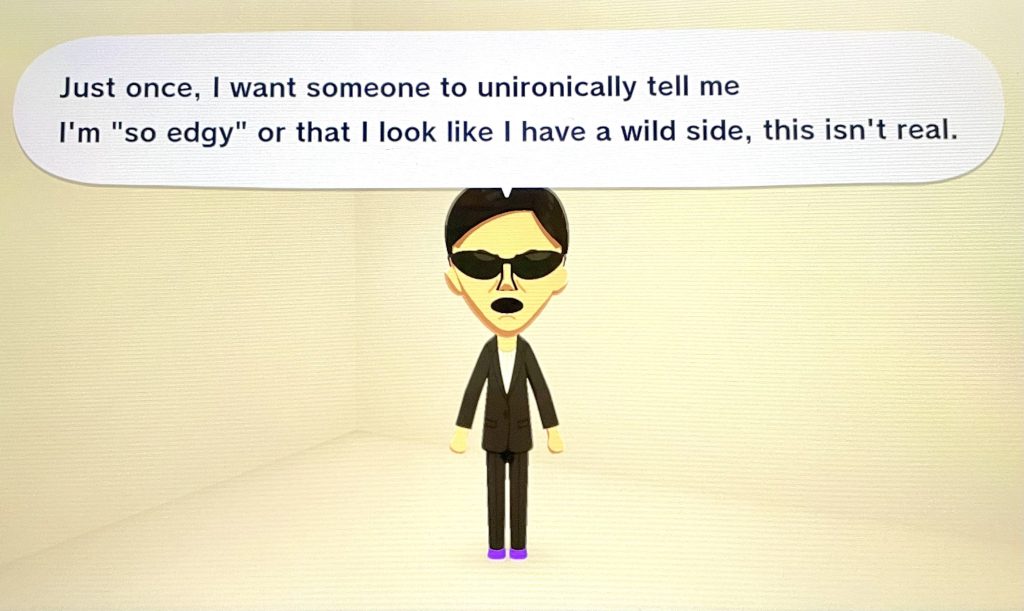
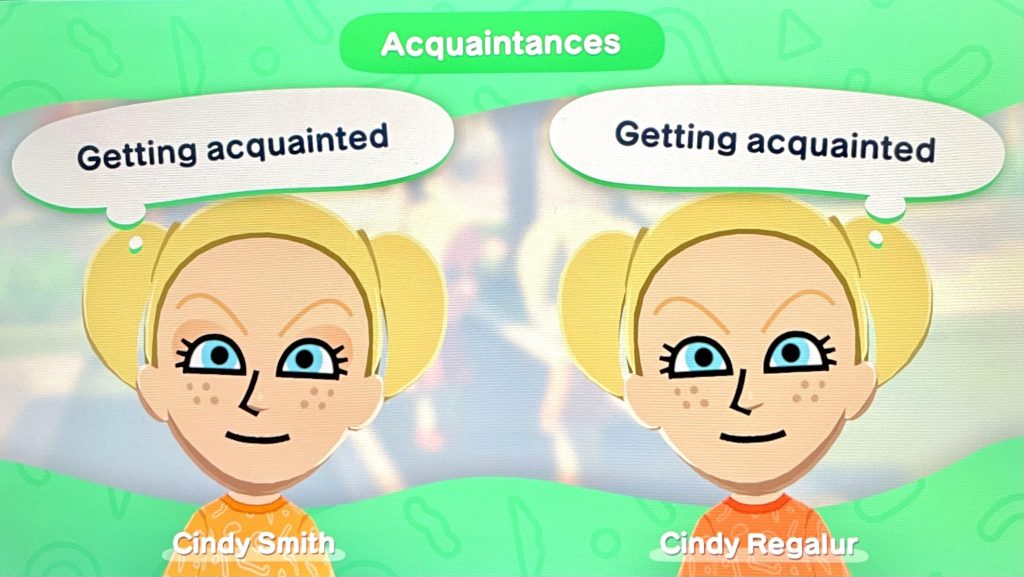
It’s been a fun experiment to see what naturally comes out of my headcanon, and fun to have a game that encourages you to make creative decisions without any heavy consequences. I’ve placed Neo from The Matrix in a blank white room to replicate scenes from the second movie. I gifted a messy art studio interior to a character a named “Cam Something” – a nod to the character Cam Cole in Ted Lasso. It was fun to think about what else he might do other than being a talented and dusty busker for a brief moment in a tv show. I’ve played with a family joke – my sister-in-law had imaginary friends named “Cindy Smith” and “Cindy Regalur” when she was young, so I made two Cindy’s that look exactly the same besides one little mole on Regalur’s face… that, and a spicier personality to fit that ‘evil twin’ vibe. All of these factors make each player’s playthrough entirely unique as a result of the culture that lives in our brains.
Serendipity
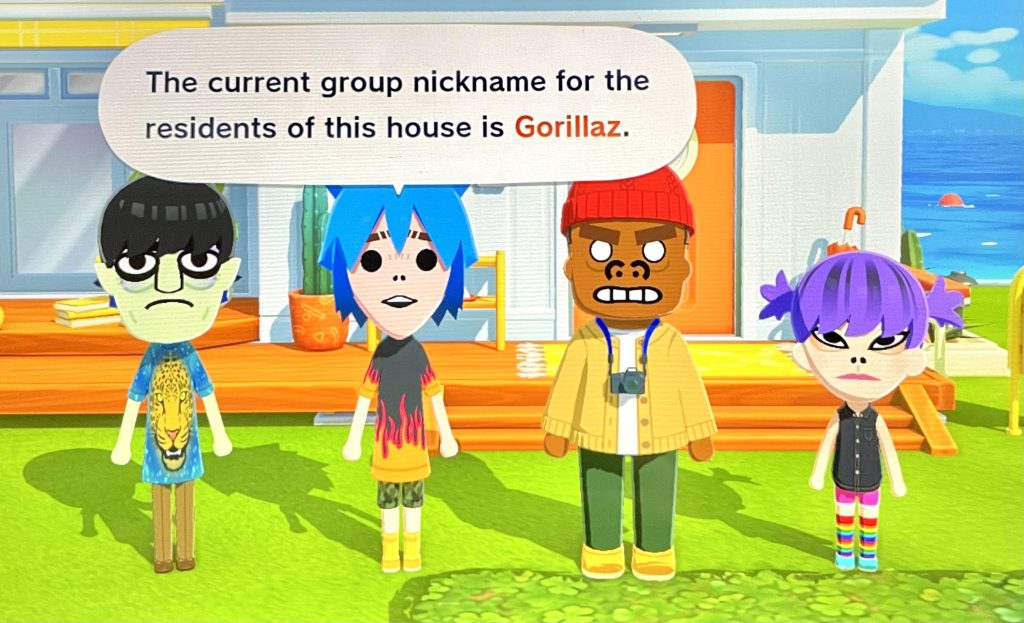
The in-game mad-libs don’t always land, but when they do, or when cultural moments naturally click, you can have this feeling of, ‘Does the game know!?’ That, I believe, is where the magic of Tomodachi Life exists. When you have a little bit of character intention and it clicks in a way that makes sense. The depth of the personality programming paired with a slider scale of characteristics, if inputted honestly, will result in characters true to the nature you see them in. For example, my 2D character (that’s his name, not his dimensionality), the ficitional vocalist of Gorillaz, leaned heavily into collaboration traits. I found this fitting as Damon Albarn – now a regular topic of conversation on the island and main Gorillaz artist – makes a living IRL by collaborating with other musicians to produce the unique Gorillaz sound. It was fitting to create Miis of the entire fictional band, and was crazy serendipitous that the two front members, 2D and Murdoc, became fast friends without too much prompting from me. The additional members, Noodle and Russel, now all live in the same house with some slight nudges from me. “The home of Gorillaz” is my first 4-person occupancy and they seem to be getting on alright.
Other combinations of natural friendships on my island are not as expected, but their juxtaposition persuades my brain to search for the connection. For instance, Heihachi from Tekken, Ditto of Pokémon Pokopia, and Brock from the original Pokémon anime series all live in the same house now. The topic umbrella expanded a bit to say these folks are all from video game fiction, and this happening of them all choosing to live together made me think that the game wants this type of connection to happen. When you take and create all of your favorite iconic characters and put them into one place, it may be more fun when they unexpectedly become friends. The game may be more fun in the random juxtapositions than the expected serendipity. We already know how relationships are organized in the real world. It feels entirely fresh when relationships are organized in a unique way that you create.
Repetition kills the magic
I want to start this section by stating that I’ve really enjoyed Tomodachi Life: Living the Dream, and hope that I will continue to in the future. I will reiterate that I do not want my most recent impression of the game to taint how I look back on the experience, however, this most recent impression motivates me to bounce off or start playing less. In a communication game, dialogue persists and characters chat over and over. Having made 20+ Miis for my island and approaching the 30 hour mark on playtime, you very easily recognize the formula. To some, that repetition and dependability may be comforting, and during some play sessions, it was for me. But the continual early-game relationship prompts reset with each Mii you create like a rogue-like you can’t find the end of.
Every time you introduce a new Mii to the island, they will be strangers with everyone, you prompt them to meet someone else, and the same sequence of dialogue happens. After some time, they will prompt you with the question of wanting to be friends with another particular character, then they will ask you what you think they should talk about, and here’s what really kills it for me: They’ll then go to that requested character, they’ll ask if they, “want to have a chat… about [mad-libbed thing you insert].” And that conversation goes one of two ways each time – either they become friends or they don’t – and often repeats lines of dialogue. I’d forgive a couple, but not that deep into the game I spotted the formula and the magic of those initial friendship requests was over.
Same goes for feeding your Mii’s, playing games with them, them asking about their outfits… it all becomes extremely formulaic and predictable. When the interactions with your Miis stop feeling novel and fresh, the whole experience becomes robotic, the magic of the surprise and delight fades away and you’re left with grinding through Mii thought bubbles hoping to see something you haven’t seen before. Even if you place new mad-libs into the equation, when only the same 3 sets of conversations are used, the joke’s over. When it stops being funny or new, it unfortunatley becomes a chore.
I think what I’d hope for near 30 hours in is more evolution of things to do or happenings to happen. It’s not that the game is void of those exciting new happenings, but I feel like I only get one every two play sessions. I’ve found myself avoiding characters that have the hiccups or that have tripped and fallen – a common prompt for a meet-cute in game. I often tell characters ‘not right now’ when they ask me if I want to play some iteration of the Shadow Quiz. It all just became the same really quick, and it feels like the game asks you then to be the one to add variety. But there’s only so much variety you can add to a core system that stays the same. It’s very clear that I’m burnt out of it.
With this rant, I also realize that the game features a skip with the pressing of the plus button. So if you already know what’s going to happen, you can skip the convo. But again, I found myself skipping everything as the novelty wore off. I also know the game has more to offer, but it’s very clear that I need a break. It is not very motivating to continue sifting through events I know the punchlines to for hours just to find one potential cutscene or happening I haven’t seen yet. Which is bummer, and like this whole post breathes back and forth, I’m sad that this is my latter impression, because my former 20 hours were an engaging blast. I want this to read as a frustration in my losing interest of a game I’ve really enjoyed.
To fight the negativity, I’ll end with a positive conclusion. Tomodachi Life: Living the Dream is a fun game that invites cultural expression and while robotic, weird, and quirky, the game is deeply human and celebrates all of our good, bad, and ugly characteristics. This game is teaching me that participation can lead to fun, beautiful and unexpected surprises. Being social and getting along is hard, but overall, it’s worth it.
I still have a ton to discover. I only have 400 out of the 9,000+ unlockable items. I think I need to learn to be okay with the video-gamey-ness of it, to accept it for what it is moving forward. I may be bouncing off or slowing down for now but I don’t want to be done for good.
Thank you for reading,
Your Friend Dillon
 Your Friend Who Likes Games
Leave a comment