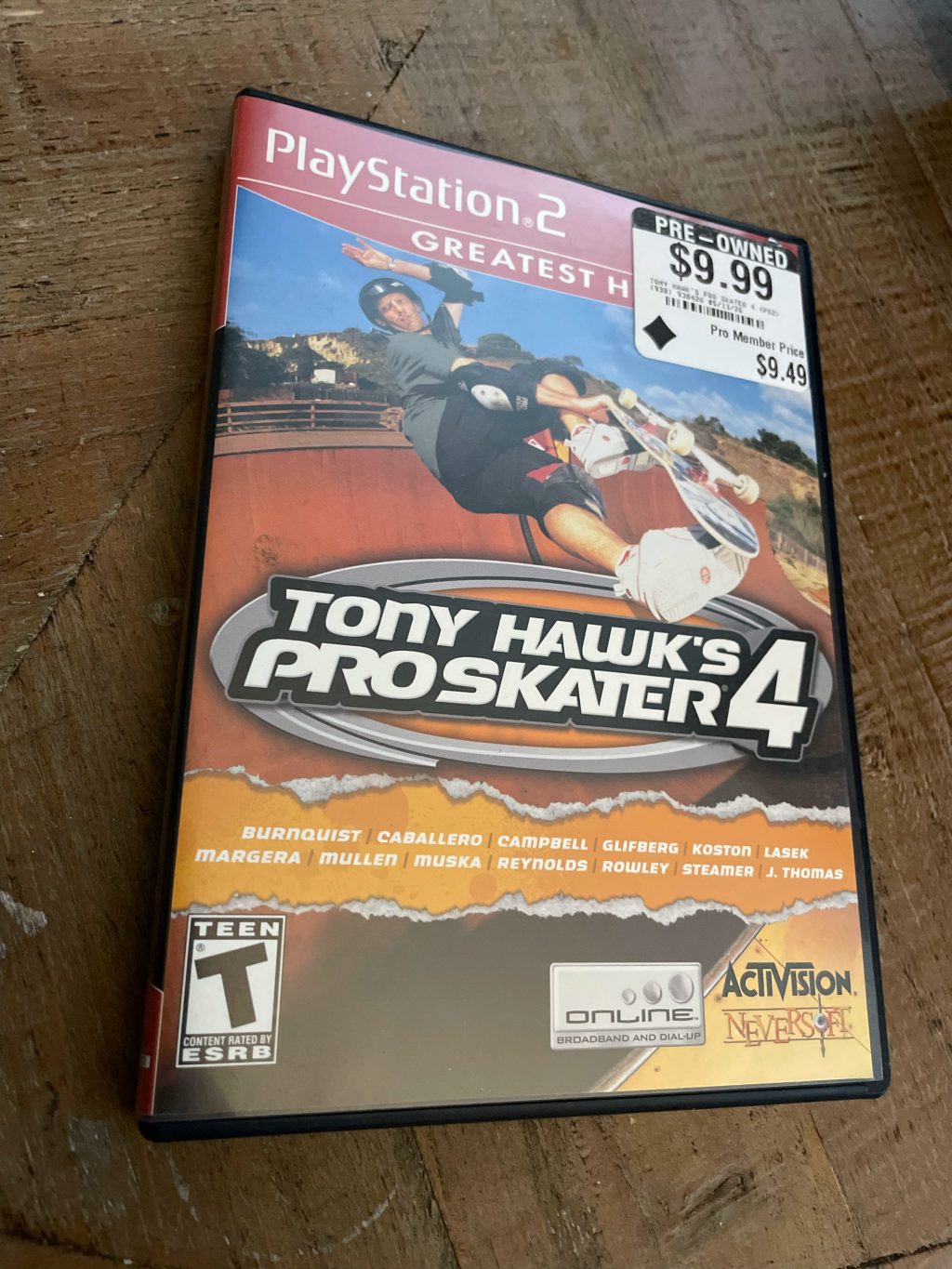
With last year’s Tony Hawk’s Pro Skater 3+4 stating the ridding of the free-roam, one goal at a time structure, I questioned what kind of remake that makes the 4th iteration of Tony Hawk, specifically. I read further that the remake of 4 simply adopted the run timer structure of games 1-3. This year, that thought popped into my brain again, and my curiosity lead me to a purchase and investigation of what Tony Hawk’s Pro Skater 4 really was.
I only remember renting this game as a kid, I don’t believe I ever owned it and my re-playing of it either confirms that thought or most of 4 has just left my brain to make room for how great Tony Hawk’s Underground eventually was. This year, I’ve really started to permit myself to play all games of interest regardless of what era they exist in. Having hooked up a family PS2 Slim to play NBA Street Vol. 2, I searched online for a copy of THPS 4 and found a used copy for $10 at GameStop. Boom, I’m in.
Early, I noted that I remember this iteration in particular felt a bit strange and different. The style and presentation had changed, and every time I completed a goal, an NPC stood, cheered, and clapped in silence after music is abruptly cut and the camera’s zoomed in on them. I found it still both weird and charming this time around, something very unique to this game. Something I remembered that has already been engrained into my soul.

The intro movie presented reminded me that these games were a vessel to share and define what skateboarding culture was. The style, the attitude, the shenanigans, the music… all encompassed in these time capsules of the early 2000s. I remember taking it very seriously as a source of cultural education in my pre-teen-to-teenage years.
I did appreciate that the game jumps right into it. You select or make a character, and an NPC simply tells you to skate up to and talk to folks with arrows over their heads, and that’s it. I appreciate the lack of over-tutorialization being that this was the 4th entry in the series. They assume you’ve played a Tony Hawk game before and let you skate right away. And I think that’s the best part of the non-timer approach: you get to free skate as much as you want until you want to do goals. And I’ll say here, I thought I would want to do more of that…
And here’s where my 4 and T.H.U.G. comparison begins, which admittedly took me by surprise. My expectation going into this game was that I would enjoy it for what it is and appreciate its first step into a new format, but there were some things I forgot or didn’t see coming. One, the levels feel tight. You feel too fast for how things are set up. I feel rails, ramps, QPs, and structures feel a tad too small or close together for you to navigate them smoothly. And that may just have been the first of a few growing pains in the series. Come to think of it, I don’t hear 4 talked about as often as 2, T.H.UG. 1 & 2, or American Wasteland. Secondly, you can’t get off your board in this game, and if they’d had figured out the need for that before the release of this title, I think it’d be more perfect, more fun to play. So you end up zooming around levels that feel a bit tight, you move automatically, and you have to hold down on the d-pad to hopefully stop in time to hit circle and talk to the next NPC. Remember too that they don’t tell you how to stop – so hopefully you already knew how.
The game has plenty of skateboardy / video gamey shenanigans, like playing tennis with someone using your board as a racket. Or racing cops in London laying on your back on your board coffin style. The problem I found here – heightened by today’s play standards – was that the controls/mechanics for the silly off-beat goals were funky and difficult. The tennis ball flies your way at impossible speed, and any louge goals (laying on your back) put you at an impossible speed and you feel wildly out of control. I have to remember that, at the time, a game’s difficulty was often purposefully implemented to prolong the experience and keep players playing. As a kid, I didn’t mind banging my head against a challenge. Today, it doesn’t feel worth my time. Especially when a goal’s premise can often sound like, ‘yep, here we go again, I’m gonna ask you to get the S-K-A-T-E letters again.’ Even the game was tired of it’s goals.
And leads me to think that Tony Hawk’s Pro Skater 4 was a giant stepping stone. It brings forth the ideas we would later find in the T.H.U.G. franchise and further, but also feels caught up in the tradition of what a ‘Tony Hawk’s Pro Skater’ game is supposed to be. What they really got right in Tony Hawk’s Underground was the why. THPS 4 presents a similar structure of level unlocking: random locations with goals to complete on-site. All minus the traditional timed run. But Underground presents a really fleshed out narrative story about a boy from New Jersey that takes risks and sets out to try get discovered and become a professional skateboarder. This game was the birthplace of a pipe dream for many youth my age at the time, myself included. But there was a reason you were leaving one place to go to another, and there were reasons you were at each location. Goals may have been similarly random and silly as seen in 4, but they either matched what was going on in the location traveled to or had something to do with the ongoing story. There was inherent motivation to complete each goal and move on from one place to another because you would be rewarded with cut scenes and narrative beats. I have more desire now to play Tony Hawk’s Underground as I unfortunately spent most of my time playing THPS 4 going, “Well, this isn’t T.H.U.G. yet.”
Regardless of that fact, you can still feel the Neversoft fun in Tony Hawk’s Pro Skater 4. They were getting more cinematic with camera changes during certain goals to add a movie-like effect. Like when you skitch a car for a guy in an attempt to gain it back, the camera is shot from above like a high-speed car chase. Or a tourist couple wants you to perform a darkslide on the rail behind them for a photo op (see below). They keep the aforementioned silliness of goals in each of these locations by again, my motivation to play kept begging for a ‘why?’

It could be an aesthetical taste thing too. I really liked being in certain levels, and really disliked others. When they’re asking you to stay in one space and compete goals, all while free-skating in-between, you want to enjoy that time. And that’s where some of these locations feel quirky. I loved the College, the first level. A great first impression to the newest entry at that time. Felt like a place skaters would want to be, and offered a good mix of college-themed shenanigans and skateboarding focused challenges.
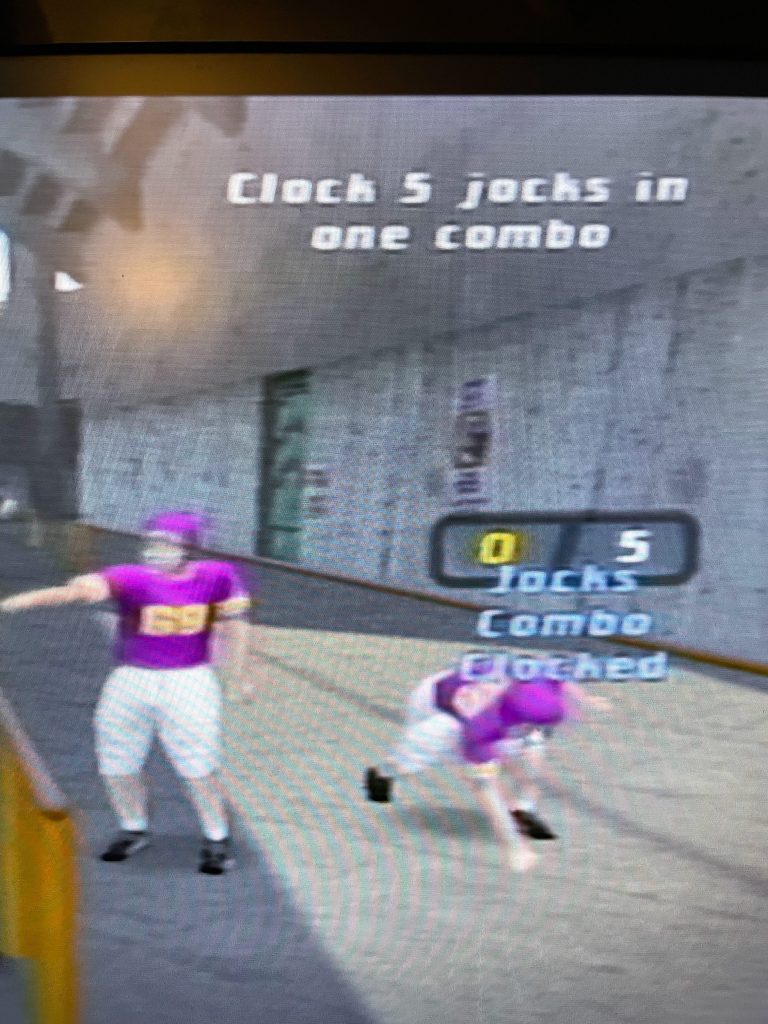
San Francisco feels good too. An urban bay area with plenty of ledges and space. Appropriate. But then the 1-3 influence comes in with areas like Alcatraz (why?), a Steelyard, a Carnival, a Zoo. Those levels feel like a joke that lands once, and by today’s standards may not be that funny or interesting. And yet again, I found myself comparing to T.H.U.G., how at least the locations felt like real places and we had meaning for being there. Perhaps this game leaned more into the video game side of things, and I enjoy how T.H.U.G. really respects skateboarding.
So, what have I learned that I’ve stated/implied a few times now? THPS 4 is not as good as one of my favorite video games of all time, Tony Hawk’s Underground. And with that premise, it never could be, but I am happy that I am in a place of curiosity and exploration that permits myself to seek out and study/play games that I may have not fully considered before – regardless of their release date. Playing this game has certainly made me want to seek out T.H.U.G. again, and I’d be surprised if a replay of that wouldn’t prove that I have most of that game memorized.
I value the power games and art have in that way. To help us revisit and value parts of ourselves, and maybe even see them in a new way.
Thanks for reading folks,
Your Friend Dillon


 Your Friend Who Likes Games
Leave a comment