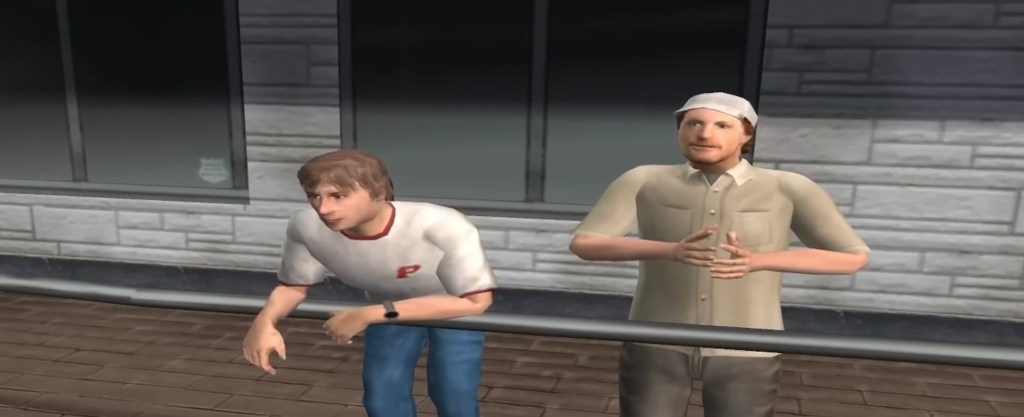
When Summer really hit, I thought about last year’s release of Tony Hawk’s Pro Skater 3+4. Then I thought about how bummed I was that they changed what 4 really was, ridding of the no-timer-free-skate structure (see previous post for more). I then bought Tony Hawk’s Pro Skater 4 with my new-found permitting of myself to play games I desire to play regardless of when they were released (a continual thank you to the boys at Into the Aether). I played Tony Hawk’s Pro Skater 4 and realized it was a stepping stone for Tony Hawk’s Underground, and really desired to play one of my favorite games of all time again. I will say, having played both back to back, while the former ‘stepping stone’ statement is true, I think they’re both significant enough to hold their own ground.
The playing of Tony Hawk’s Underground in addition to the variety of physical game titles I’ve obtained through re-sale seredipitously or maybe ironically coicides with Playstation’s recent big news to stop producing physical media in 2028. I’ve felt myself gravitating backwards for a few personal reasons.. one being that I got really burnt out of tolerating indie games that didn’t always feel like full games. I feel like it became popular to release something that had one note, or a game that simply does one thing, and one thing only. A cheap, expendable and short experience. I know that’s a broad stroke and a bit mean, but it painted a majority of my 2025 and in doing so built a desire in me for fuller games. Other reasons involve the frequently mentioned reading of Keza MacDonald’s history of Nintendo book, purchasing a Nintendo Switch Online subscription, and discovering my local re-sale store, all events building a curiosity and permission to see all games in existence as available to play and collect for various prices.
But with PlayStation’s recent announcement, another motivation comes into play: preservation. Now, I can’t say I’m surprised. I can’t say I’m anti digital game. For the past 5 years, I’ve exclusively purchased digital games for play convenience and to not take up physical space in my home. I am, however, anti removal of ownership. If people have purchased games, they should be theirs. But sadly, I can’t say I’m surprised at that either, as frustrating as it is. I’ve admittedly seen new game purchases as an expensive ticket to an event, one that you then obtain access to. I feel foolish a bit now to say I’ve bought into the convenience, not fully comprehending they can rip the rug out from under us whenever they want. I’ll still buy digital games from Nintendo in the near future, PlayStation feels sour right now. Hopefully we don’t get to a point where all companies can’t be trusted but maybe we are already approaching that. It’s too grey and complicated to pretend that I have all the answers. Finding and buying a physical game I can play on an older system feels a bit more secure of an experience now. As always, we will see what the future holds. For now, let’s talk about Tony Hawk’s Underground 🙂
T.H.U.G. is in my blood
I played this game religiously 20 years ago. Finished it countless times. I didn’t realize, or maybe forgotten, until playing THPS 4 and building desire to replay it, that Tony Hawk’s Underground is one of my favorite games of all time. Feels cliche to write. It feels just as good today, and comparatively plays better than 4 – the environments have much better flow and being able to hop off your board makes navigation of physical spaces with a skateboard more natural. The environments feel more thought out, more authentic, and more balanced in a way that matches the pattern of combo flow the gameplay points you to at this era of the franchise.
I tried ‘Sick’ difficulty this time around and exposed my gamer ego. The game read, ‘for players that have mastered the Tony Hawk games.’ My gamer ego thought I fit that description and took on the challenge, and honestly, all but the last goal in Moscow I was able to achieve. If I felt like continuing to bash my head against it, I suppose I could do so but I chose to watch the remaining cutscenes on YouTube to conclude my playthrough this time around. Did you know there’s an alternate ending!? A small, but very cool difference. Check it out at the end of the video at the link below!
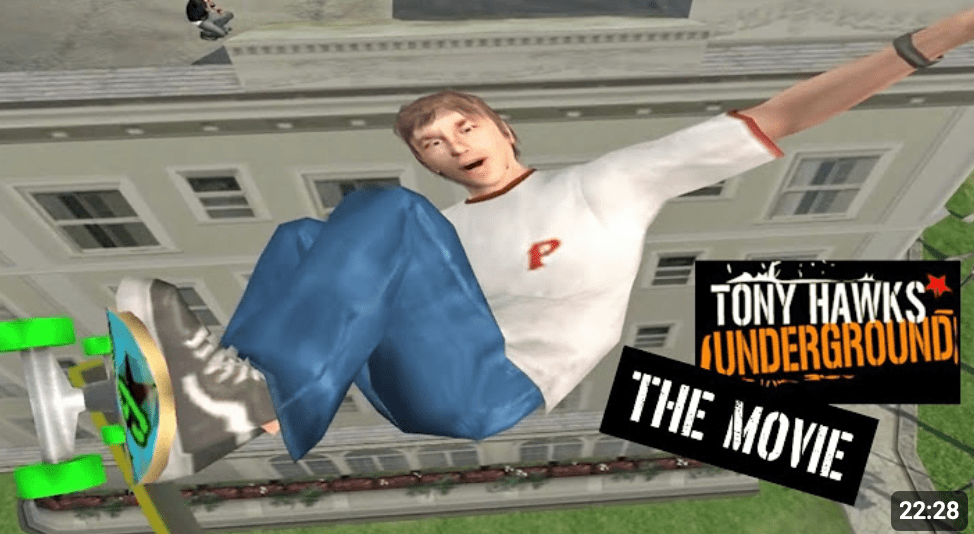
Tony Hawk’s Underground: The Movie (All Cutscenes)
I’m still impressed with how gripping the story and filming of it was for the time. I feel like they had people motion capture and act out all the scenes – made for a movie feel in-between your goals in each location. We have to remember that this was nearly an entirely new approach for the series and they hit a home run the first time. The story single-handedly implanted the ‘I’m gonna go pro’ pipe dream into my 13-year old brain. Starting at the local suburb of New Jersey, then hitting NYC to film tricks in bigger locations, trying to make your way into the amateur contest in Tampa, skating for your team in San Diego, going pro in Vancouver… I felt all of it. That dream was enough to believe in and keep me skateboarding for 10 more years after starting at 13. I knew by 16 that I wasn’t going pro, but it didn’t stop my love for skating, and I have this game to thank for that. And while I could observe that 13-year old a bit through this playthrough, I still felt the story was impactful and concise.
I enjoyed how with each beat of the story in which you’d gain a sponsorship, or go to the cold city of Moscow, your character would gain or shirt or top that would match the story happening. A little detail that carries authenticity of the narrative. Your whole UI menu and theme even changes after you choose what team you want to skate for. I forgot how you build character stats by completing certain performance tasks. For example, you can improve your Manual stat by completing a manual for over 10 seconds. The hard part of these, is that your character is barely good enough to perform those tasks (really exaggerated on Sick difficulty) so the game can really ask you to grind it out. I didn’t bother much this playthrough unless I felt it was necessary, and that really bit me in the butt on that final Moscow goal. Felt like I entered a boss fight with low stats and under-armored. But I like the RPGness of that stat structure.
I forgot that you can create tricks, and eventually design and create your pro model of board in this game. Both things that my 13-year-old self took very seriously and identified with – passive this time through – but new, exciting features when the game came out. The game felt like it lasted forever as a kid. I remember each location feeling like it took longer, but I think that’s because they lived in me. By today’s standards, I wouldn’t say the game is short but I’d say it’s efficient. The story beats move along nicely and there’s no more than 5 goals to complete in each new story context/location you pursue.
Lifelong T.H.U.G.s
The friend I grew up skating with and playing Tony Hawk’s Undergound with is still the longest lasting friend in my life by far. I’ve known him since I was 3 years old. Thankfully, he’s not an Eric Sparrow in my life, he’s a good friend with a big heart. I found a ton of joy recording our favorite cutscenes from the game and sending them his way. It’s hard, I know one has to be in the right headspace to visit that nostalgia, but he caught it with grace. We shared laughs through text, and reflected on how the game actually has a great script that still makes us laugh because it’s funny, not just because we were kids. Since the early 2000s, any time the word or context of ‘skills’ is presented in conversation, you’ll hear one or both of us quote:
“Skills! Skittles means skills! Whattare you from Idaho!?”

Grieving
This playthrough of T.H.U.G. created a grieving process for 35-year-old me, though, one that 13-year-old me wouldn’t find necessary. I felt feelings of foolishness having bought in to how simple it was to go pro, at least in this game. Even though I more than likely knew I wouldn’t, a kid growing up in a small farm town in rural Ohio had plenty of space to dream. I was one of 3 total skateboarders I knew. We had space to dream and skate free of comparison or competition of others. There wasn’t anything in my face telling me I wasn’t good enough, just camaraderie and love for an activity that gave us the feeling of freedom. Tony Hawk’s Underground sparked a dream and belief that we didn’t just have to accept the limitations of our location. My mom still reminisces about the ‘neighborhood skatepark’ we had among friends and houses – each location offering a different rail, box, and/or quarter pipe that we’d session every day after school.
A more contemporary sense of grieving felt with this playthrough came from the point of the story. What I took from the story as a teenager was a direct role-play of the journey in becoming a professional skateboarder. This time around, I really saw how this story looks to portray the death of innocence, freedom, of enjoyment when you turn something you love into work. Tony Hawk’s Underground illustrates the politics and unfortunate behavior around the culture of becoming a professional skateboarder. Drinking was really a thing. They use it as a tool to show us that making money skateboarding can very quickly get away from skateboarding, and more focused on partying. I think, as a kid, I couldn’t tell if it was sad or cool. As a person that hasn’t touched alcohol in nearly 3 years, I interpret the story as a sad portrayal. And the story isn’t unaware of this sadness. I feel like I felt it as a kid but felt like I was supposed to think drinking was cool – so sad on the inside, but laughing on the outside.
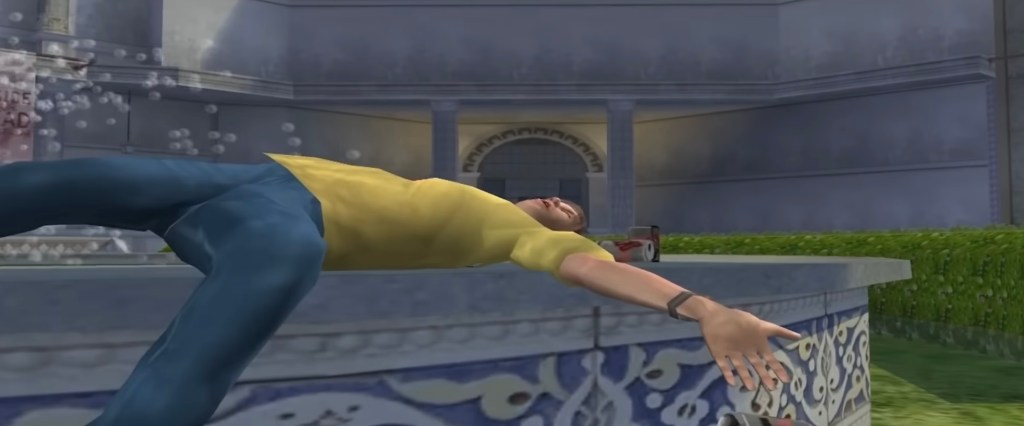
Tony Hawk’s Underground illustrates the sad truth of what people can prioritize with money and success, and how that can kill the art, the joy, the passion of the original intent. I was in a small garage band with friends in middle school, but ultimately drugs became cooler to them than practicing did. In my early Art Education career, I said yes to everything in hopes to gain opportunities, but my youth and aspiration just got used and taken advantage of. I saw a parallel when you travel to San Diego in-game and do the team’s grunt work. Or when you’re in Vancouver and shoot filler footage for everyone else. The communities we enter into can kill a pure heart, can feast on young energy and then we lose the point. But that’s not the end of the story.
Let’s beware of the Eric’s in our lives
We all hated Eric Sparrow. It took a 35-year-old brain to realize they may have parodied Tony Hawk’s name? Regular first name with bird last name? Recognizing this, I named my main character this time around Dustin Finch. Eric had his moments. Moments where I, like the main character, over-trusted his friendship. But ultimately, Eric just looks out for himself throughout. After failing to sign you up for the Tampa Am, stealing your secret spot footage, and drunkenly hijacking a tank into a wall and blaming you for it, he ends up becoming more successful than you – especially in American terms. Money, custom car, body guards and agents – he’s illustrated as quite the asshole at the end of the game. And after all he’s done, he has the nerve to call you and Stacy Peralta’s team, shop, and practice ‘ghetto.’ Says he’ll buy you out for half a mill and write a check on the spot.
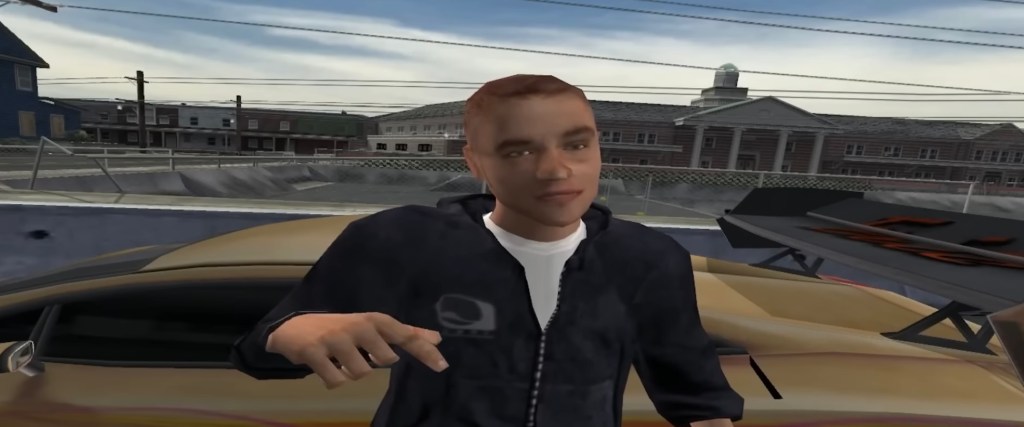
You remind him that it was ‘never about the money,’ but it takes your character a homecoming to remember that. At the end of the game, you come back to New Jersey and complain to Stacy Peralta about how skating used to relax you, not stress you out. He then reminds you,
“That’s your deal man. Skating is whatever you make it. It didn’t change, you’re the one that changed. Now go skate! You’ll remember why you started in the first place.”
Beautiful. And so true. Video games changed for me when I put the pressure of a podcast around it, and are still different for me now that I take notes and write, although I feel a bit closer to that natural joy more than I had before. Artmaking is different for me now that I’ve wrapped an Art Education career around it. Riding a bike became different when it became my exclusive mode of transportation. But if we can find those moments where we can afford to do it for ourselves. To just enjoy playing the game, to free ourselves on a bike ride, to just draw without worry of outcome, that’s when it’s most pure. Closest to its original intention.
Keep it true,
Your Friend Dillon
 Your Friend Who Likes Games
Leave a comment