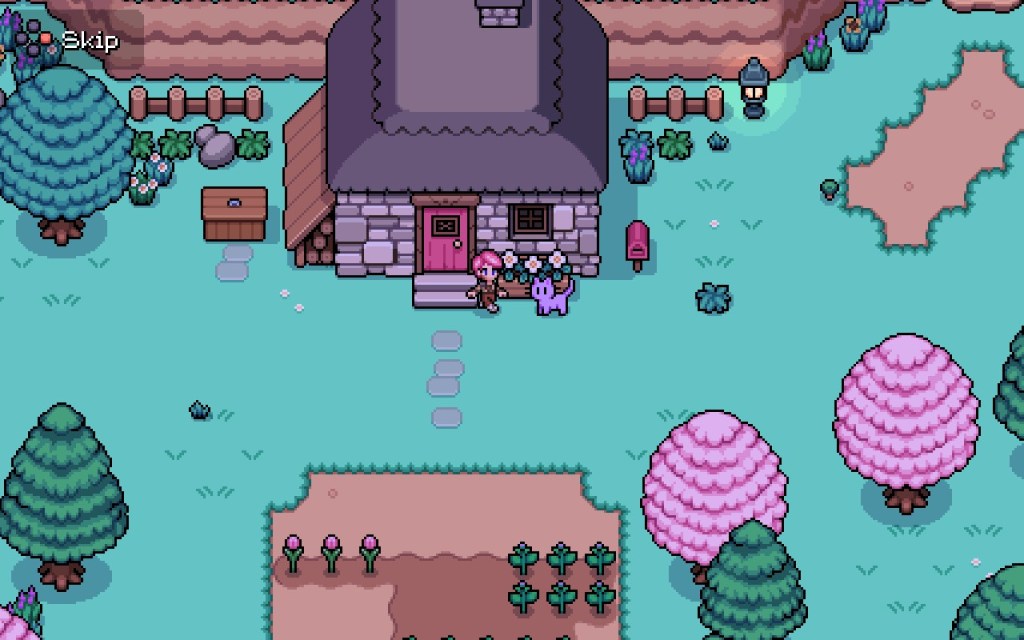
I played Fields of Mistria at early-access launch 2 years ago at a time when I had first started the podcast with a friend and was figuring out what it could be. I remember being obsessive with the project, attempting to try every game I’d heard of and talking about it fast to claim a take on each experience. To the point where I wasn’t really playing or finishing anything, but instead just making sure I had something to say. The pressure of inserting myself into the online space and into a gaming culture with thousands of new releases to play turned me into an ADHD mess that I think, unfortunately, became the overwhelming force that pushed my friend away from the project.
I was heartbroken but understanding why he didn’t want to continue. I turned a hobby we loved into work. The baggage of the break-up stayed attached to Fields of Mistria and I pushed the game away for a bit. That, and every time I tried to play, I couldn’t get past the notion that the game wasn’t Stardew Valley.
Fields of Mistria certainly doesn’t escape a comparison to Stardew Valley and it’s developers are fully transparent in how their game is in direct conversation with it. I, personally, felt at the time of first playing it in early access, that I still had some unfinished business with Stardew Valley. But Fields of Mistria 1.0 comes at a good time where I feel I’ve seen, played, or at least know of mostly all of what Stardew has to offer, and I’ve worked on properly grieving any podcast baggage I may have (though, always a work in progress).
I hopped back into Fields of Mistria more confidently with a 1.0 release and open to the question of, ‘will it stick this time?’. Since the time of their early-access release, I’ve kindof made a rule for myself to be careful with early-access games. I definitely burned my perception of Chef RPG by playing too early, and now with any new releases I’m more likely to wait for 1.0. 1.0 presents a game with confidence and says, ‘this is the version of the game that has everything in it that we had initially intended including fixes from playtesting and player feedback.’ So to answer the question, ‘will it stick this time?,’ I don’t want to jynx it, but it certainly feels like it will this time around.
It’s nice to play and not have to wonder if the game will be too different in the future. It’s nice to play knowing they’ve now added what they want to and it’s the full game as intended. In comparison to my first play in early-access, it feels like they’ve pinpointed all of the areas where I had that ‘this feels kindof empty’ feeling with either happenings, quests, dialogue, or scenery filler that is necessary for it to feel complete. This playthrough, one in which I restarted again and dramatically titled my farm 9th Try Farm in hopes that this one sticks, I made it to Summer in a breeze – I hadn’t made it out of Spring in my previous attempts. And I think that’s a testament to content added that keeps things moving and keeps habits stacked so that you continue to be engaged in playing.
I feel a big comparison point to Stardew in regards to quality of life improvement is that Fields of Mistria communicates to you directly what you need to be doing. I enjoy that each item description ends with what you can do with it. Items either say ‘often used for cooking,’ or ‘used in certain crafting recipies,’ or ‘makes for a great gift.’ In games like Pokemon Pokopia and Stardew Valley that bombard you with materials in which you’re not always sure of their intended use, you can certainly feel a sense of overwhelm with storage and material management. I know you could argue that the lack of telling you exactly what items do can create an online or secondary culture around the game, but it’s nice to not need to constantly look things up while you’re playing. Fields of Mistria is okay with your play being fast and successful.
I continue to love the pixel art style and classic RPG cinematics that use both the sprites in the world and portraits to illustrate conversation and happenings. Makes for both memorable gaming experience and creates a world that feels bigger than the one you’re allowed to occupy. I like the mentioning of The Capital in the game. Again, great world building that places Mistria, the place that you come to know and occupy, into a bigger world that can see beyond the bubble that makes up the game. I’m connecting more this time to the town’s characters and the lives they live. The boys at Into the Aether had commented on their “Penn & Tetris” episode how the characters don’t just sit and wait at spots for you to arrive and talk to them, but rather have lives of their own that they actively live within the game whether you visit or not. This I’m sure not-so-simple-and-lots-of-work-to-program fix in comparison to Stardew and other games in the genre creates a sense that you, the player, become a part of a living community.
In regards to the rest of my playtime beyond this blog post, I may need to let Fields of Mistria simmer and stay patient with it. Feels weird to write though, because at least for this past week, I’ve been really engaged with it. I think what I mean is that I need to let this game be in my life and keep pecking at it while I permit myself to play other games. It’s clear that it will be a long haul, and like I did with Earthbound, allow myself to write about it in various contexts. I think I’m getting better at doing that overall. Allowing myself time with games creates richer writing and experiences.
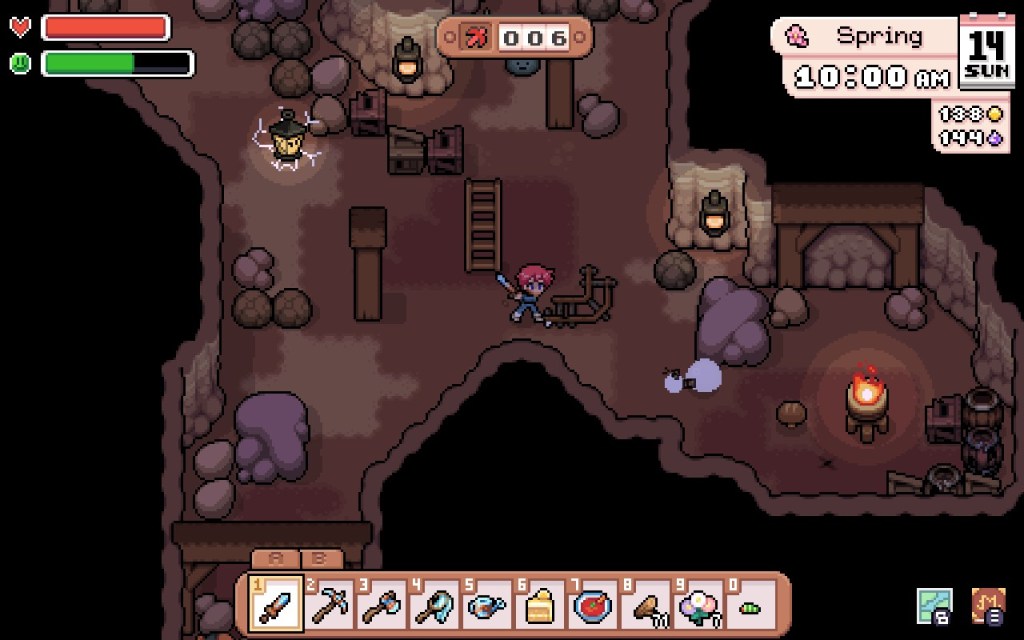
One thing I’d really like to point out that I noticed from the 1.0 polish is how fast and smooth the gameplay feels. From being able to quickly move about the world (in case you didn’t know or haven’t played, you can both swim and jump in this game), to quickly navigating menus, to seamlessly moving in and out of cutscenes… it feels like Fields of Mistria was play-tested and polished to the point where you can intuitively play as fast as you think. There’s no notable frustrations when it comes to navigation of the world, menus, or executing any part of the gameplay. Not only that, but note that I’m saying it all feels good from the start, AND there’s options to make the gameplay even better!
Through various dragon statues, you acquire skill upgrades that you can apply to the various activities you perform throughout Mistria. Some notable favorites within my first season were:
- When mining rocks, there’s a chance a rock will explode and break multiple other rocks around it.
- Unlock and excute a jump attack that creates a damaging circle that hurts surrounding foes.
- Fish will become attracted to your bobber from a further distance away.
- Increased chance to find stage-appropriate armor within the mines.
Again, in conversation with Stardew Valley, they’ve looked at all of the components of the game and asked, ‘how could this be improved?’ And it’s not to say that Stardew Valley is a bad or worse game by any means. I don’t think it’s fair to compare the two. Fields of Mistria does not exist without it’s predecessor Stardew Valley, and it very much knows and respects that.
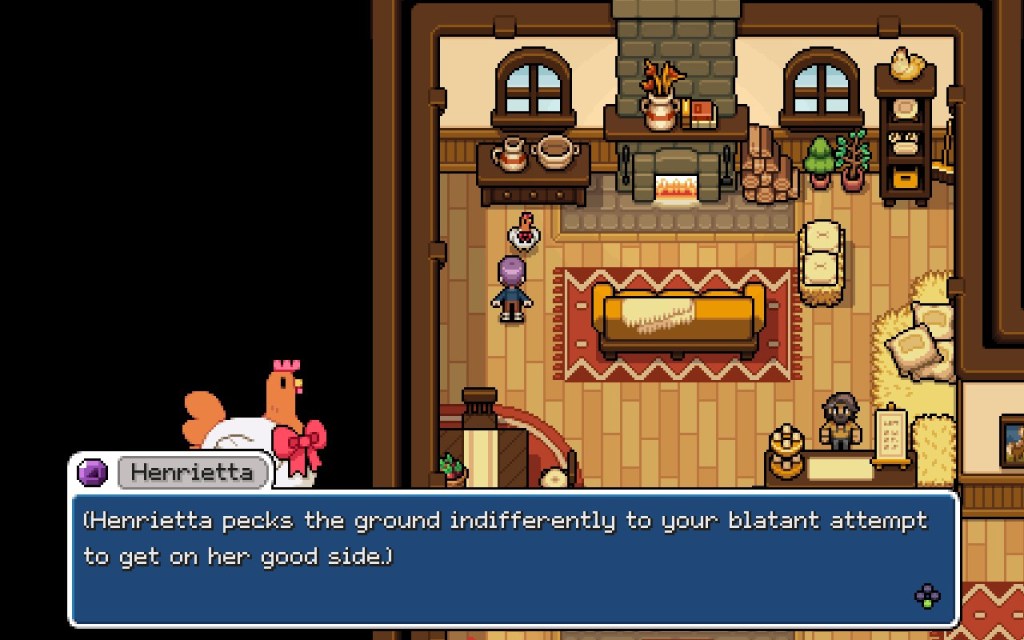
Call me a golden retriever, I love to fetch. Fields of Mistria is full of fetch quests that give you reason to explore or participate in all parts of the game. Whether a character has put in a request for something foraged, planted and grown, cut down, forged, caught, or cooked, the request board in the game gives me a reason to do so. I’ll bring up Pokopia again in comparison, a game that felt like it simply said, ‘You can do all this stuff if you want to. You have the ability.’ And then leaves the motivation to be the responsibility of the player. Fields of Mistria giving you a simple, ‘I’d love some potatoes for a recipe I am working on’ and then you get rewarded in friendship, currency, and items to do so is motivating. Stephen at Into the Aether mentioned this too, that it’s great that none of those quests are timed by day and do not dissappear. So no stress as to when you get them done – they’ll remain on your list until you obtain the item, creating excitement when you either find the item or obtain the ability to make it, knowing the character that requested it from you will be excited to receive it.
Speaking of completing quests and conducting your business in-game… I love that Fields of Mistria allows you to enter spaces at what feels most hours of the day, you may purchase items from stores on a trust-based system that does not require the person running it to be there, and you may complete quests and carry out what you need to do that day EVEN IF a festival is going on. It’s not a cut-based, all-day affair that you have to attend exclusively and burn a day to participate in an egg hunt. In Mistria, you can turn in items to a character even if they’re in the middle of their Friday night D&D Night and the Inn. You can walk through the Saturday Market and still catch bugs. It’s great, and maybe one of the biggest QOL improvements in comparison to Stardew Valley.
Two features I don’t remember seeing the first time around but am very excited to see and am happy about this time around are the Lost & Found box and Elsie’s Daily Gossip. The Lost & Found box is a box that you unlock and can visit every Monday. Inside the box each week will be any item that was left anywhere in the game because your pockets were too full at the time to pick it up. HUGE. I now have zero hesitancy to catch any bug or fish, or to harvest any item in sight. Since unlocking the box, I’ve comically made quite a mess of Mistria. Elsie’s Daily Gossip allow you to talk to her and get hints at what gifts each character likes. So for those you may be persuing a romance with or want to get to know better, a great tool to have in game.
At the time of writing, I’m still very much looking forward to more. I’m looking forward to discovering what I’ll end up doing to my farm, I’m excited to witness stories of characters that continue to enrich the world, and I’m excited to hopefully see all of the game’s seasons and beyond. As always, we will see 🙂
Thanks for reading folks! Take care.
Your Friend Dillon
 Your Friend Who Likes Games
Leave a comment