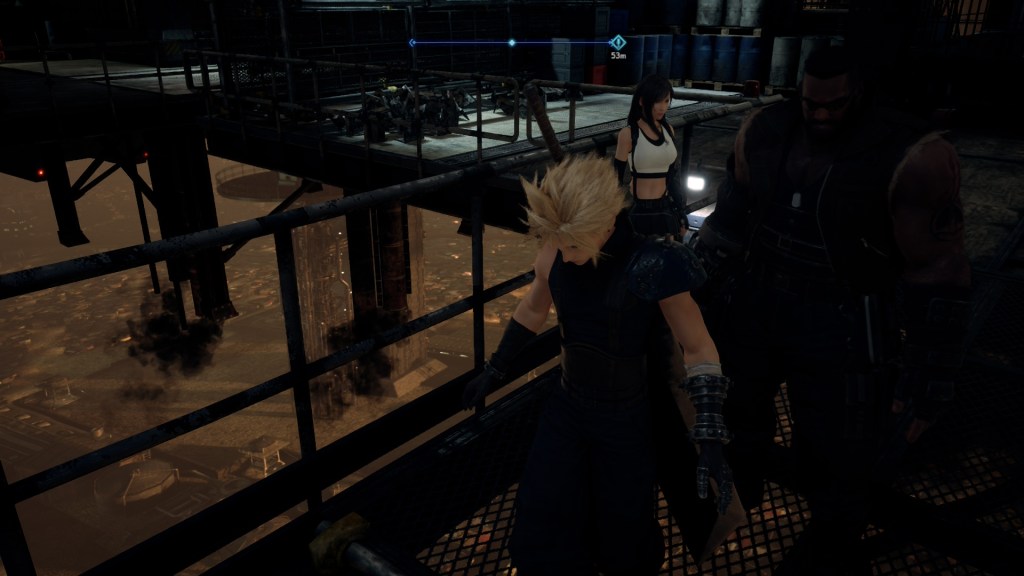
My first stand-out moment from this section of play was recognizing that the Shinra exhaust up top points downward toward The Slums. Such a visual of oppression. The structure alone is enough to communicate to those below that they’re lesser-than, but the small detail was just another layer of metaphorical communication. Another sad reality of the world of Final Fantasy VII Remake Intergrade is that a lot of the folks below have accepted their lot in life, regardless of how clearly unfair it looks from the view of the player.
I’ve switched to Easy difficulty at this point, as this game feels like a 40 hour movie that I don’t want to stop watching. The combat is cool, but in a game that has a gripping story and a higher hour count, I’m not motivated to grind time attempting to get good at it.
Cloud loves to let everyone know he’s just in it for the money. But we have the luxury of seeing him begin to build bonds and connections with the other characters he meets. And when we get him dancing, we already know he’s more than along for the ride.
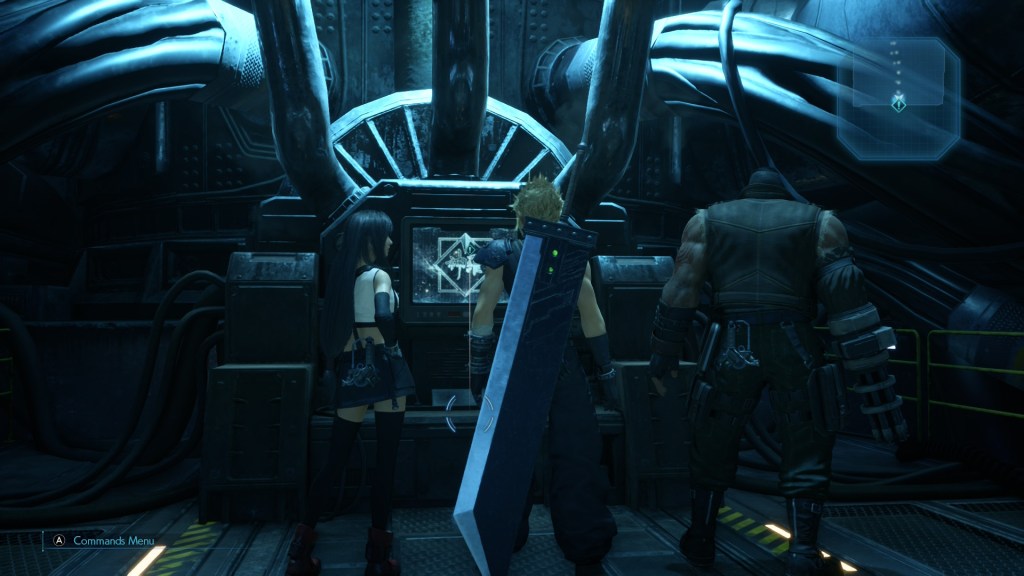
I found myself nostalgic for the first mako reactor as I approached the bombing of the second one. It has a near identical set up to the first and I reached it about 7 hours into the game. The moment created an in-game nostalgia for me and added more weight to the 7 hours played. Made me think and reflect on the journey had up until that point. I have to remind myself in these bigger, 40-hour games that most of the time, 7 hours of playtime is a full indie game. I can beat myself up sometimes, feeling like I haven’t ‘accomplished’ anything in game but what that really means is just that I haven’t finished it yet. If I collect and value all the memories made in 13 hours played to this point, I can find the richness in each hour and allow myself to savor a special experience.
There’s something special about a small party of a few looking to take on giant forces. The sense of scale in Remake does a great job of making you feel small, but you trust in the powers of your companionship and know (or at least believe) that they’ll find justice.
It’s good for my brain to start recognizing moments in game and bridging them to moments I remember from the original game. Initial moments with Aerith are memorable in both games, and when I started to recognize, it was fun to anticipate how they’d handle certain moments in the new iteration. I was curious if I’d be throwing barrels down from the rafters, or what the sleazy Don Corneo would be like in Remake. Was quite the performance – you almost feel bad for how troubled he is, but then you remember how gross he is and will be happy if he receives his due.
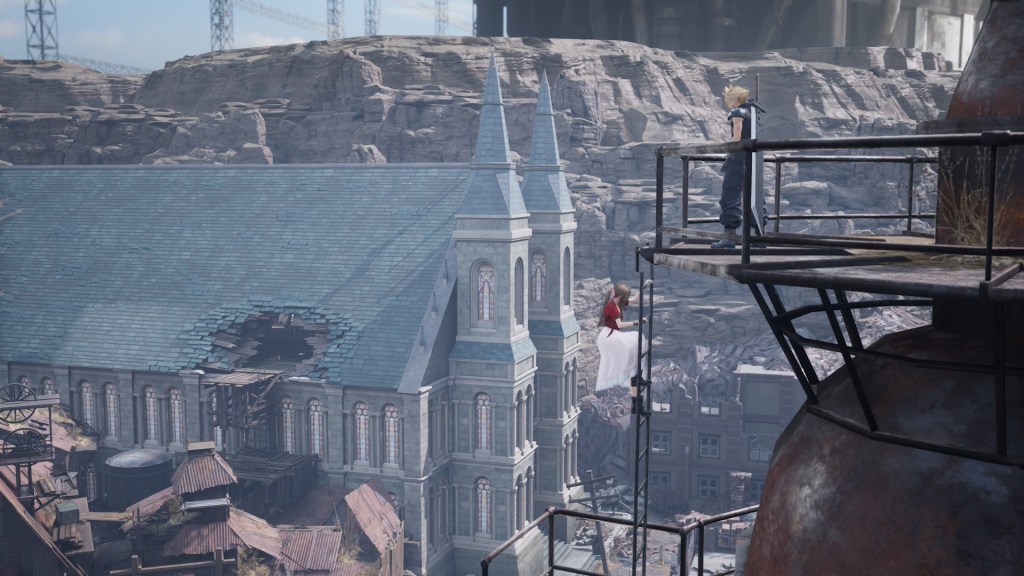
The rooftops scene with Aerith were, other than the tutorial blowing up of the first reactor, some easier-to-recognize moments from the original game and created that thought of, ‘Oh, I remember this.’ The artistry in framing where Cloud fell from the sky and into the church. A direct and serendipitous moment where his fall creates a hole in the ceiling that will provide more light for the flowers to grow. Visual metaphor and storytelling left for interpretation and not entirely spelled out, but I think the emotion that a lot of players come to this story for.
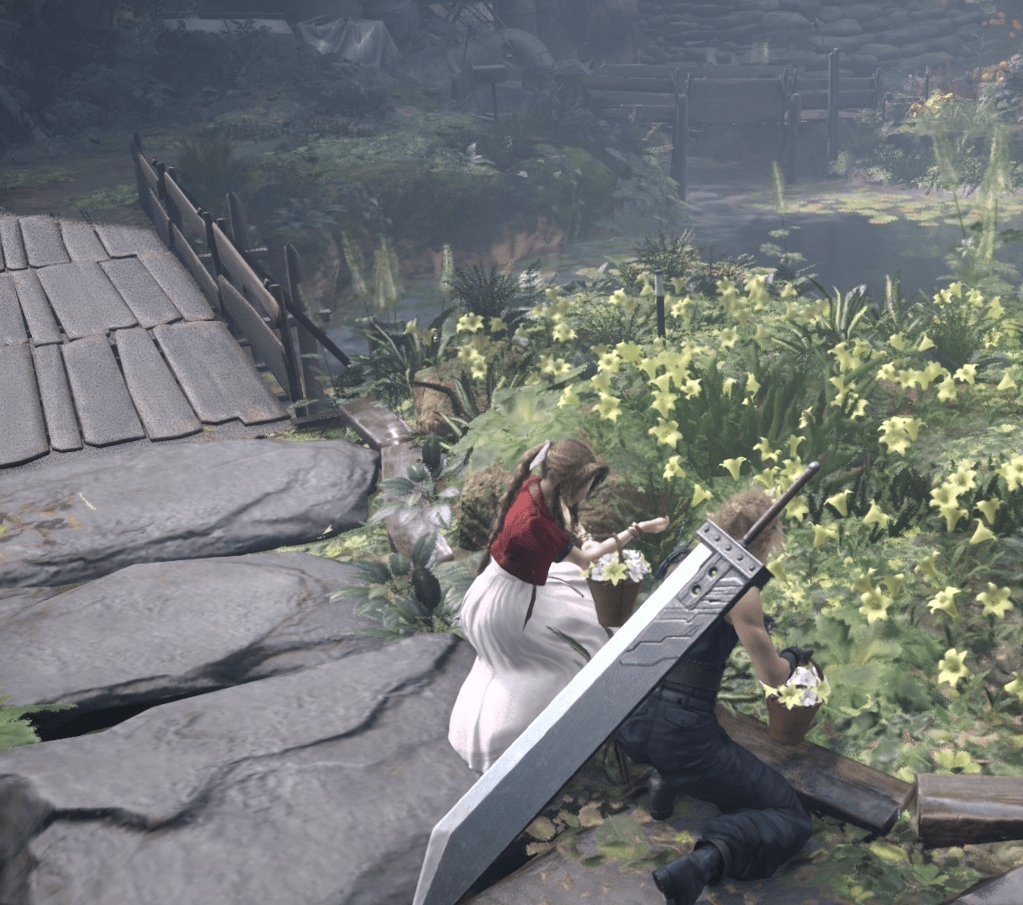
In regards to moments being recognizable, I think we can thank the iconography of the scenes. I think the initial scenes with Aerith stick out because it’s one of the first times we see glimpses of nature and environmental beauty within the over-industrialized and oppressive infrastructure the game throws you into. The dance of conversation you have waltzing across the thrown-together wooden rooftops to the then surprise of greenery, growth, and natural life found around the corner at her house. The contrast tells a very fast and sad story. It reminds you very quickly that you haven’t seen much nature, and that while all the pipes, machines, combat and epic music were really cool to start the game… once you realize why you’re there, Aerith’s house is a sad but hopeful preservation.
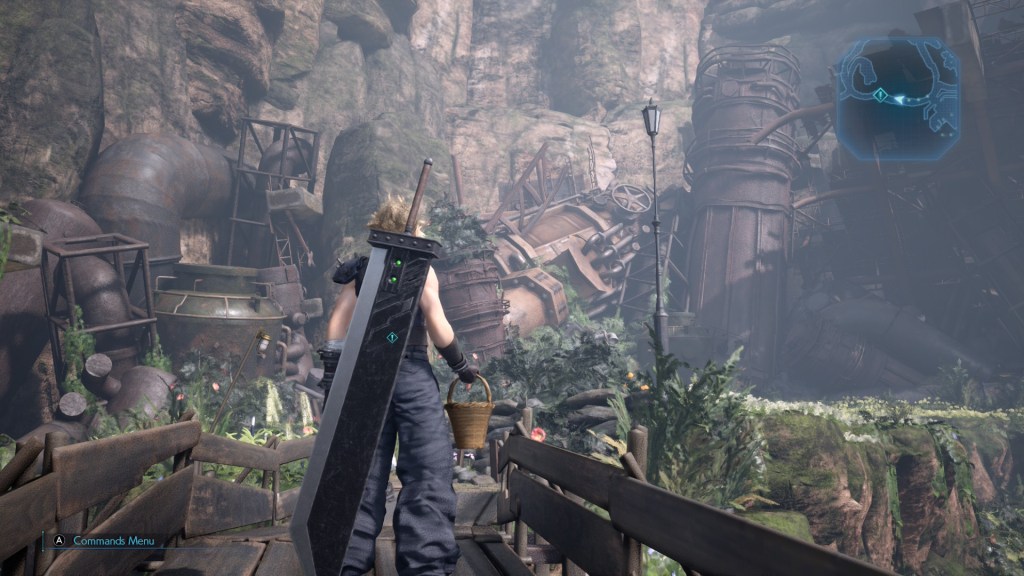
Aerith ultimately becomes Cloud’s ego-killing humbler. We all know he can use it. It’s interesting, I think he may have been potrayed as much tougher in the late 90s, and while he’s still a respectable warrior, it’s quite obvious that this game by modern cultural standards looks to kill the tough-guy facade a little more. The facial expressions in which Cloud realizes his vulnerability are being tested don’t escape the frame. It’s like he’s learning to be how he wants to be because of his SOLDIER background, he’s not sure how or physically / mentally may have difficulty doing so.
I find Aerith inspiring. She has an outlook that may appear like blind optimism from the outside, but I feel she very well knows the gravity of living situation. Regardless, I feel she does everything in her power to help. This fact was strongly illustrated in her relationship to the orphanage. In a place like the Midgar Slums that can feel absolutely hopeless to most players, Aerith vows to do what she can with what she has. I think the player is the only person in the game’s relationship that has the luxury of seeing how bad Midgar is. I remind myself that some of the game’s population were more than likely born into it and don’t know any better. I can’t say injustice isn’t seen – Avalanche proves that.
Speaking of the orphanage… I found it interesting that Cloud tells a child very confidently, “I used to be a SOLDIER.” To my knowledge, I don’t remember him bringing that up to any of his peers. Other adult characters in the game either remind him of his ex-SOLDIER existence illustrated by his green-ish eyes, or Cloud mysteriously tries to hide that fact as a working mercenary. But telling a kid that he used to be a SOLDIER implies that Cloud may feel the kid may find his skills to be of value and heroic. A small place in which Cloud may feel powerful and proud of the skills he has and may put in play to be useful in a situation. To any other adult, he’s clear that his skills come with a price. I found that moment interesting.
It’s no mystery that Cloud’s time as a SOLDIER left him scarred. So much so that connection with others suffers. A simply high-five with Aerith after some puzzle-soliving proved to be complicated, awkward, and intimidating for him. His SOLDIER training proves him to be a mechanical weapon, but I continue to enjoy how the story and the characters he interacts with provide opportunity for him to practice new vulnerabilities. An amazing challenge of the male ego in 1997, and one that still – certainly and unfortunately – feels very useful today.
A skill of his I didn’t notice until about 12 hours in was that when you are victorious after a battle, Cloud does his signature sword spin and locks into the victory pose like he did in the original game. I can’t say I’m incredibly familiar with the original and I’m sure there’s plenty of references I’ve missed, but it’s been fun to pick up on the ones I can recognize.
The fighting tournament you and Aerith are forced to enter in the quest to save Tifa from Don Corneo contains some proper cultural commentary. Displayed through crowd behavior, the team of two only receives cat calls for Aerith – objectifying her from the start with no real connection to who they are. They win, and the audience becomes angry. “YOU COST ME A LOT OF MONEY!” shouted from the crowd. All of a sudden, the audience has lost power in their expecations and therefore you are a threat to their comfort. And here’s the real commentary: as soon as you keep winning, the perception of your team very quickly shifts. All of sudden the same people that objectified Aerith, expressed anger toward a lost bet, are now the same folks placing money on your victory and cheering for you. Audiences and people like this that are often loud in order to show others how powerful they think they are, are often just the ones who contain the most insecurity and lack the ability to think for themselves.
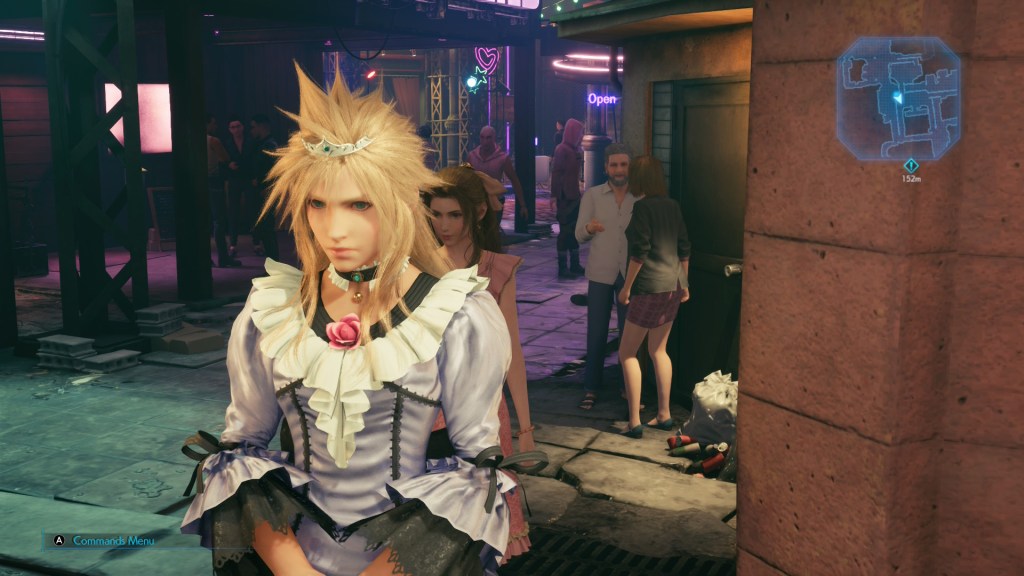
A modern addition, and a welcome one from my perspective, was the Cloud dance number with members from the Honey Bee. Dancing is the last thing you’d expect Cloud to want to do and turns out he’s quite good at it if you hit the right button inputs at the right time. The ending sentiment stated to him that he can hold beauty regardless of gender was great. A more detailed piece on this very moment in game is found in Mothership Blog’s post titled, “Final Fantasy VII Remake makes queerness visible – but confined.” Link to the article is below, and if you’d like consistently quality video game reads, I recommend a paid subscription 🙂
I’ll say that, when I believe it is Tifa, first sees Cloud in the dress and shares commentary, he very quickly responds, “NAILED IT. I KNOW. THANK YOU. MOVING ON,” while the statement still holds a ton of shame and does not celebrate queerness, I think the most important expression here was ‘thank you.’ I caught the thank you quick and tagged it as a ‘thank you for thinking I’m beautiful in this dress, I felt beautiful in it too.’ Cloud of course would never say that at this point, but I at least felt that he walked and carried himself very confidently while in the entire ensemble. A tad less shame expressed from him this time around than in comparison to the 1997 comparison point (which I noted before maybe not as bad as it could have been but I could be wrong?).
I did actually find one part of Remake that I thought was a little less impactful than in the original game. In the quest to rescue Tifa from the Don Corneo mansion, there’s a cut scene in which 4 men get Don’s ‘leftovers’ – a.k.a. the girls he didn’t chose to be his next temporary bride (gross). It’s obvious in remake what is implied will happen the closed room, and Tifa of course kicks their ass in a cut scene. Happy justice was served of course, but I found the original to be a bit more impactful to me during this sequence. In the original game, I remember you had control of Tifa at the time inside of the locked room, and the men then slowly approached and attempted to corner you. Impactful may not be the best word, and I think the cutscene approach was probably the better choice, but I guess my hope is that other men who had played the original sequence and were put in her shoes felt how terrifying and gross that was. I remember it legitmately made my body warm in a cold sweat kind of way. My eyes grew wide in disbelief. You kick their ass in the original too, but the choice to have you, the player, be slowly pursued like that, I hope, was an intent to end that kind of disgusting behavior.
I look forward to more impactful memories made on this journey. I find myself nearing that half-way point of the game and I’m sure I have plenty more to experience and write about.
Thank you for joining me on this one,
Your Friend Dillon
 Your Friend Who Likes Games
Leave a comment