Truck-kun is Supporting Me from Another World & moody gaming contexts
Truck-Kun is Supporting Me from Another World!?
I feel like I played this game in a vacuum. I had a scenario where baby boy was sick and needed to be home so I, dad, needed to be home too. I took a day off and while he rested, I started and finished Truck-kun is Supporting Me from Another World!? that same day. It’s not a very long game, I probably logged 5-6 hours. I couldn’t put it down.
Truck-kun is the most indie-ass game I’ve played this year by far. Up front, I’ll say my only real gripe with the game was that it didn’t run great, even on the Switch 2. Perhaps it didn’t help that I had, right before starting, checked out what the Kirby and the Forgotten Land DLC looked like on Switch 2 – it looks amazing and motion is incredibly smooth. But I forgive Truck-kun, being that it’s an indie game and regardless of the framey performance, was still very fun to play. It certainly did not have the same kind of Nintendo budget and backing as a Donkey Kong Bananza or Splatoon Raiders – two games that also feature a ton of on-screen destruction all at once.
Chris Plante, video game journalist and co-host of the podcast The Besties and more recently solo-host of his own show Post Games, had an interview with the dev of Truck-kun that I now would like to go back and listen to having played the game. Among other things, the developer Xalavier Nelson Jr. explains the lore behind isekai in anime. It’s when a character is suddenly transported, summoned, or reincarnated into an unfamiliar or paralell world.
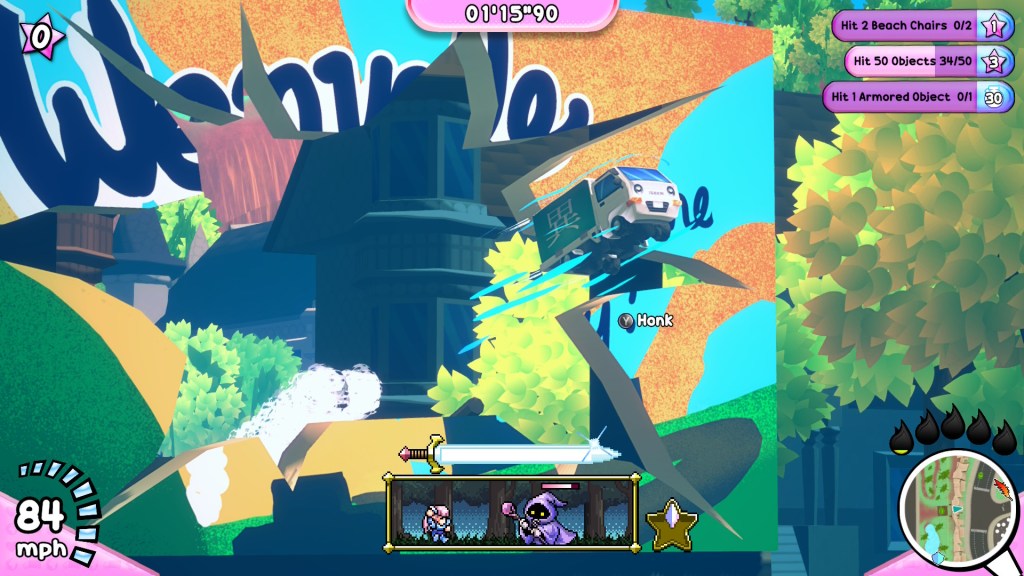
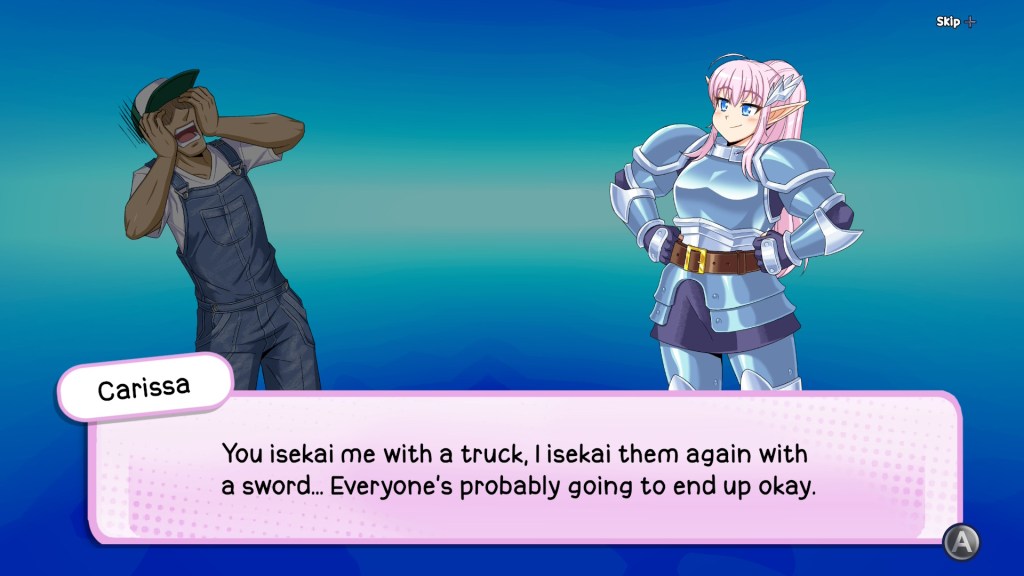
This game starts with the main character, a delivery truck driver, hitting a woman in the street. In doing so, he ‘isekai’s’ her to another world. That world now happens to show up in pixel art from in a horizontal strip at the bottom of your game screen. She feels you owe her a life debt, as you’re still able to communicate with her from the other side, and explains to you how this is all going to work. In order for Carissa (the name of the woman you hit) to get out of that strange new world, you need to isekai more people into that world so they may become enemies she can fight and defeat to earn stars. The more stars she gets, the more progress she makes, and eventually, when she’s leveled up enough, she can take on the Skelton King. So how do you then isekai people over to her? Well, the same you isekai’d her – you have to hit them.
Your new job them, driving your delivery truck, is to drive quickly and hit pedestrians to send them over to the world Carissa is now trapped in. But that’s not all… Carissa can’t fully defeat enemies until her sword slash meter is filled up. How do you fill up her sword slash meter? You hit every object in sight. You then become a conduit of chaos and attempt to run into everything you see. The game becomes a very engaging balancing act of hitting both people and objects to give Carissa enemies to fight and the power to defeat them.
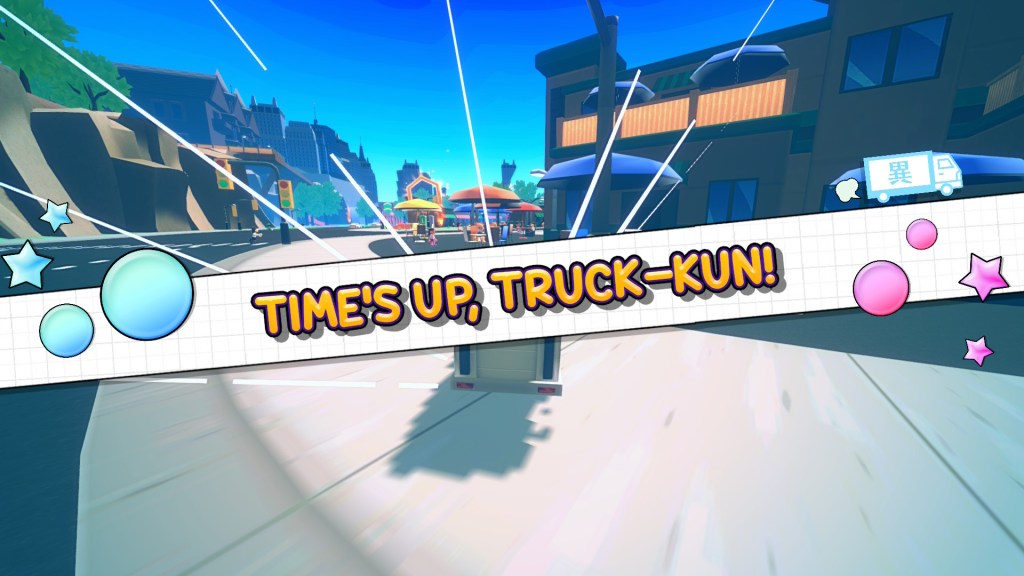
Time is a factor in this game that I didn’t quite understand at first but later understood why it was a choice. A timed run harkens back to arcadey style play we found in games like Crazy Taxi, and small snippets of play creates a structure that kept me coming back for one more run. It’s like when a book has small chapters. You feel more accomplished completing something and are more likely to keep going than if the entire book, or in this case, city, was presented to you all at once with no checkpoints. Too sandboxy and open then – requires the player to create motivation. No thanks.
Giving you a start clock of 1:30:00 mixed with objectives that go up in size creates a frantic and fast nature of play that I think the game desires you to have. Completed objectives either give you more stars or more time in your run. Objectives can range from things like “Hit 5 fences” or “Hit 10 parked cars.” Stars earned help your progression, but Milestones move the game’s overall progress forward. When you check off Milestones, the game communicates to you that the story is moving with narrative beats featuring text dialog and character portraits.
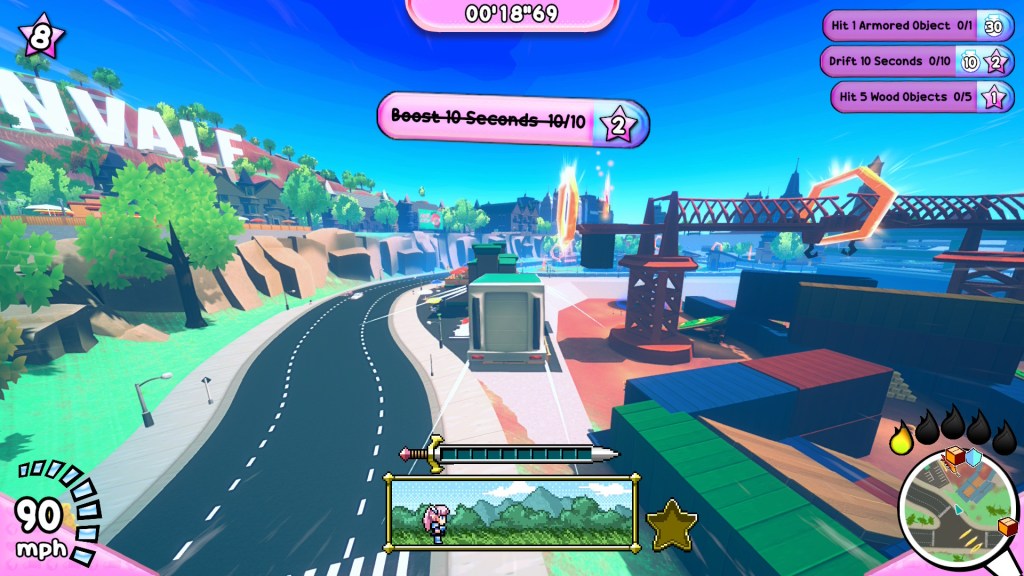
It was interesting, I found it more difficult than expected to hit anything on purpose. I think I’ve been trained by various driving games to click left and right rapidly in a balanced manner in order to stay true and straight. But left and right in this game are comically jerky to the point where doing anything confidently is wishful thinking. It creates magic though. I found myself unexpectedly checking off objectives because I had happened to hit 5 beach chairs and 10 wooden items in an attempt to also successfully jump through a “Style Ring.” I found myself more successful when I let the kind of open, zen flow to happen while also trying to maintain focus. It can be so stimulating that it’s calming.
I compare the flow vs. disruption feeling in this game to the Sonic franchise. It hosts those moments when you feel the flow, feel like you’re ’doing it right’ as you successfully complete objective after objective… to then suddenly slam into a tree or get stuck in-between a wall and a building. The equivalent of that fast and flow of a Sonic game abruptly stopped by a set of spikes and you’re left to clean up your mess of rings. Any sort of successful flow in Truck-kun feels more lucky than skill-based. I found it best to try to let the driving/navigation to be a little more abstract, a little more happy-go-lucky, and just take what I could get while still moving toward objectives intentionally.
The city is a really important factor here too. It took me quite a few runs to realize that they aren’t plopping you into different locations each time. With the objectives asking you hit specific things before your time runs out, it’s important to know where you can find those things. The Milestone goals grow numerically throughout the game, asking you to make the most of and make more out of each run. Therefore, by nature you are motivated to memorize where everything is in the city. Now, what’s nice is that there is multiple places you can find wooden fencing, parked cars, hedges… Though I found cafe tables to be particularly challenging to find and hit as they’re sort of hidden in the middle of town within alleyways and outdoor plazas. Beach chairs are easy to remember where you find them – the beach! Duh! Buttttt there comes another brilliant factor of this game’s structure: you then ask yourself, “Can I afford the time to drive all the way there?”
A place like the beach is only in one location on the very edge of the map. Hence a sense of strategy needs to be in place and you are answering the question, “What objective is the next-quickest to achieve and where are those things in relation to my current location.” And what keeps the game incredibly engaging is that you are asking that question every 5-10 seconds.
One thing I do remember from the Post Games episode with the dev was that they discussed video game language and how video game developers now can assume we players understand a variety of common language. I don’t mean written language, but rather things like how to drive a car. Or how to discern what objects are breakable and what objects are not (trees won’t budge). Or that it’s okay to not drive on the road, on the correct side of the road, or hit pedestrians in this fictional world! These are all things that can be understood from the games that we have already played or are a common understanding of things that are possible in games. If I’m not making much sense here, check out the episode for the real deal. It’s titled “Games Are Better When You Give a Shit and Pay Attention.” Again, the show’s titled Post Games. 🙂
If any of you happen to play this, I’d be curious to know your thoughts on the metaphor the gameplay presents in conversation with the corporate ladder parody/grind the character Carissa presents. My take is that the gameplay is meant to mirror Carissa’s go-go-go, get better, do better, grind to be the best mentality. You hear Carissa’s story and mentality and wonder when she’ll realize that she’s enough. And with the game progressively getting more challenging by asking you to do more with the same amount of little time, it had me asking myself, “When do I feel like I’ve done enough?”
Turns out, I was determined enough to see the game and feel that sense of accomplishment. But it also feels like contemporary indie games (thinking of Titanium Court) have things to say our desires or needs to be productive and play video games at all. It’s interesting…
Some moody gaming this week
Other than completely ripping through Truck-kun is Supporting Me from Another World!?, I am having one of those weeks where I feel like I’ve been playing both everything and nothing. I’ve broken my rule of no more than 3 games at a time and I’ve been dipping into sessions of certain games to fit certain moods and contexts. All are games that, as of late, I haven’t really committed to, but have been sort of pecking at. It can fun and freeing… I enjoy that I’m permitting myself to play what I feel like playing. But as someone with ADHD tendencies, I have to be careful. I observed myself getting into a place where as soon as I boot up one game, I’m thinking about playing another one. With my brain all over the place, I tend to session a lot of games instead of digging deeper into a couple games. So I thought it’d be fun to explore that behavior here, and through reflection see if I can influence how I play moving forward. That doesn’t have to necessarily be the goal, but I’m curious what it’ll do to my brain and approach. Let’s do it.
When I’ve wanted to get lost…
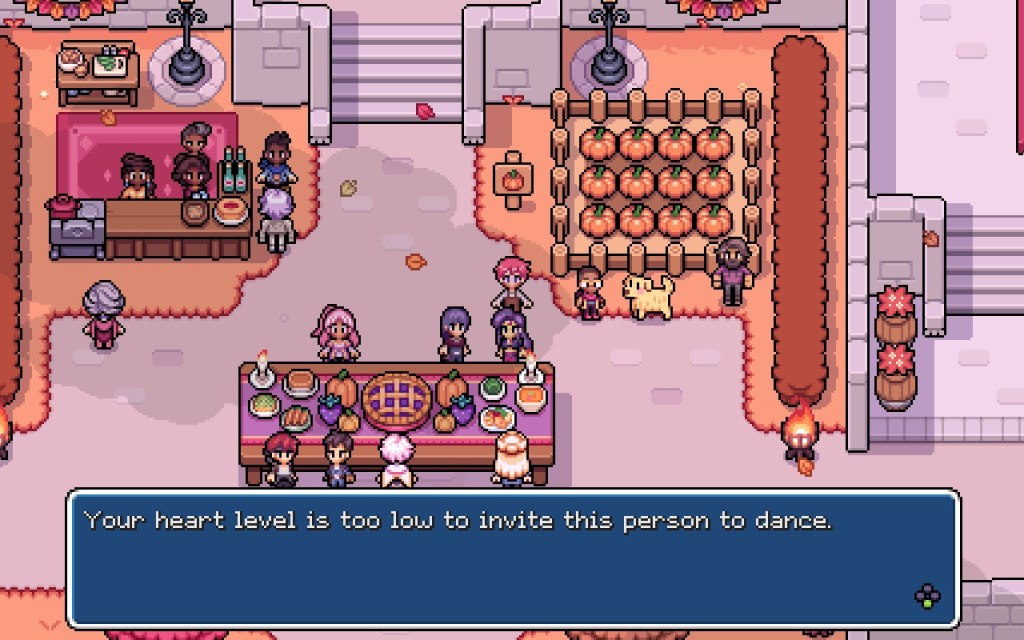
Fields of Mistria. I want to want to play this game. And that’s not to say I haven’t enjoyed it. I’ve played 20 hours of it this year since 1.0 dropped. On one side of the coin, I tell myself to just play the game – to walk around, engage with stuff naturally, and do what I feel like doing that day. Get lost in it and understand that these games are infinite and progression will happen. But the other side of that coin is that progression is not just automatic, but rather requires self motivation. It requires self-motivation to obtain certain items to craft items people want or items required to make a thing that’ll be a new system for your farm/life. My wall can be when too many steps are required to obtain and craft and a thing and then I stop caring. The game can ask you to work for things in that way and it can be a barrier to my continuing.
When I need progression to be automatic….
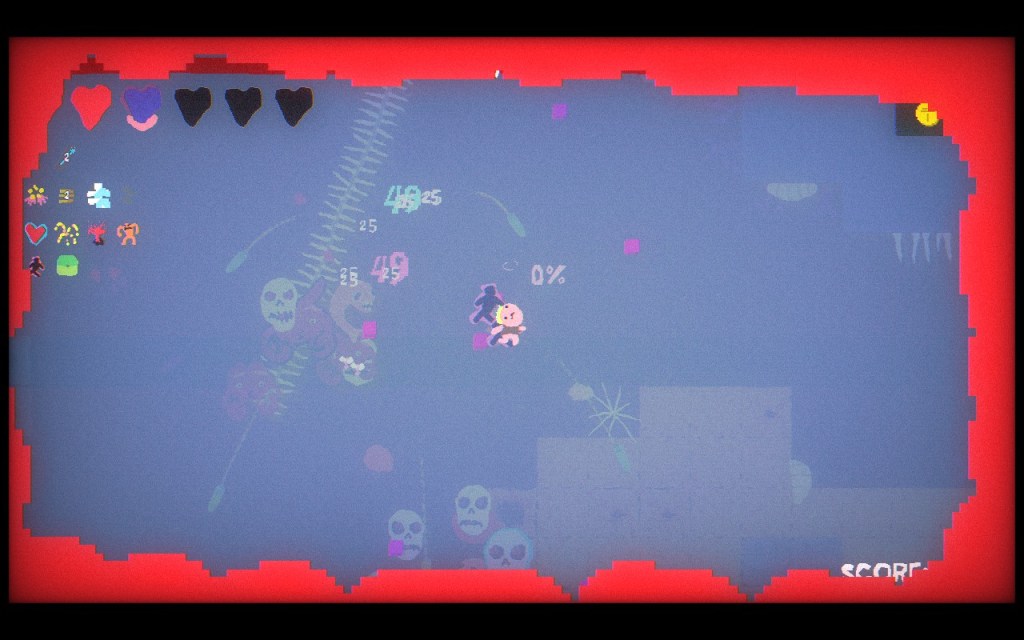
Blood Dungeon. Unfortunately, at times, a little too automatic. Though, I’ve had some evenings after very overstimulating workdays in which Blood Dungeon evens things out in my brain. It’s like how folks listen to fast metal music to feel an ambient sense of calm. Sometimes my brain’s level of stimulation is so high that I need something to match that energy in order to feel calm. Blood Dungeon doesn’t ask too much from you past your automatic attacks and navigating some simple 2D-platforming. It features gaming languages I already know how to speak and then the action of gameplay is engaging enough. So when I need my stimulation matched, Blood Dungeon is a great fit. Beyond that context, I’m finding less and less motivation to play because I feel like I know what it is and that there’s little left to discover… which as I write this know isn’t true. There are plenty more weapons and upgrades to keep the game evolving, but the repetition along the way can be a barrier to continuing.
When I want to watch a movie…
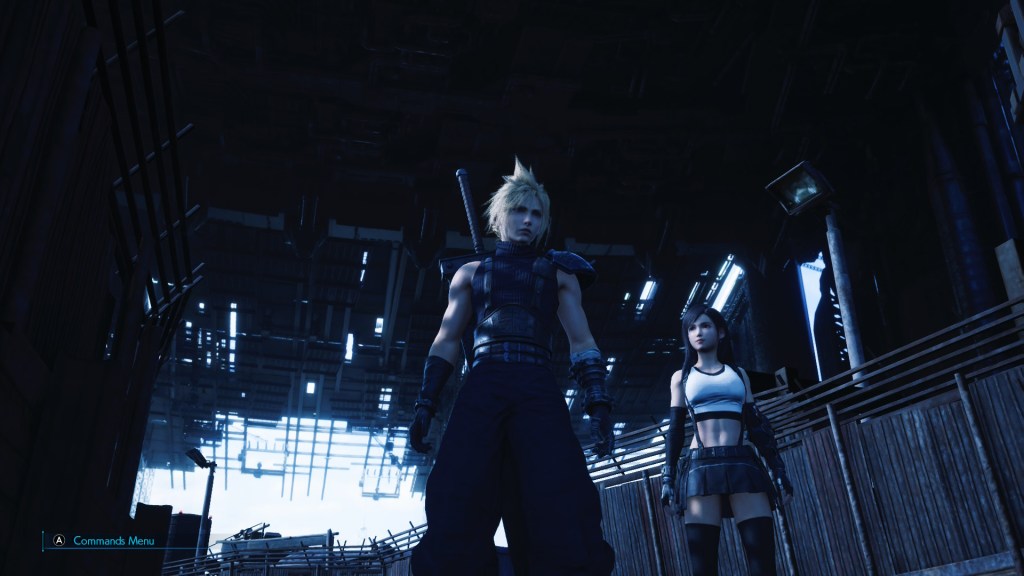
Final Fantasy VII Remake Intergrade. I strongly desire to see this game through. I’d love to play all three of the remakes. The cinematic structure of this game requires a specific play context from me, one in which it can have my full attention and be played on the big screen. That play context isn’t always available in my household, so on those weekend nights when the family is asleep, I try to take advantage. It’s a game I want to savor and not just passively play handheld on Switch 2. The scale and presentation is impactful on the QLED TV. So my time with it is certainly not complete, but momentum can be tough to maintain when I am not finding the gaming context to play it.
When I miss my friends…
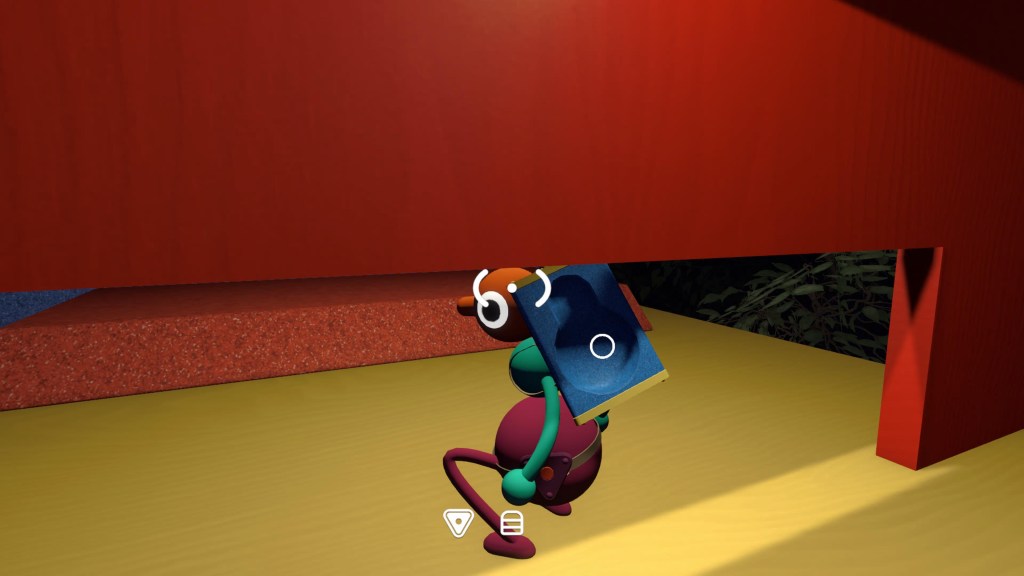
Big Walk. And thankfully I don’t have to miss my friends too much. I’ve had a weekly game night with my two besties for a few years now. It’s great. Can serve as both a needed vent sesh and a triangle of support we all give each other. Ironically, Big Walk has been so wildly engaging and immersive that we don’t talk much. So while for the past month and a half, we’ve been playing Big Walk each week and I miss them. We play and are creating amazing new memories together, but haven’t talked life much during these sessions. I’ve requested during our next session that we have a small sit-down before we head out of the main lobby to do a quick catch up on our lives. Let me say too… and more on this in future I hope… I’ve been amazed at how Big Walk has taught my friends and I that we have the ability to communicate at some levels that we would never experience together otherwise. We are thankful.
When a Mega Man costume becomes free DLC…
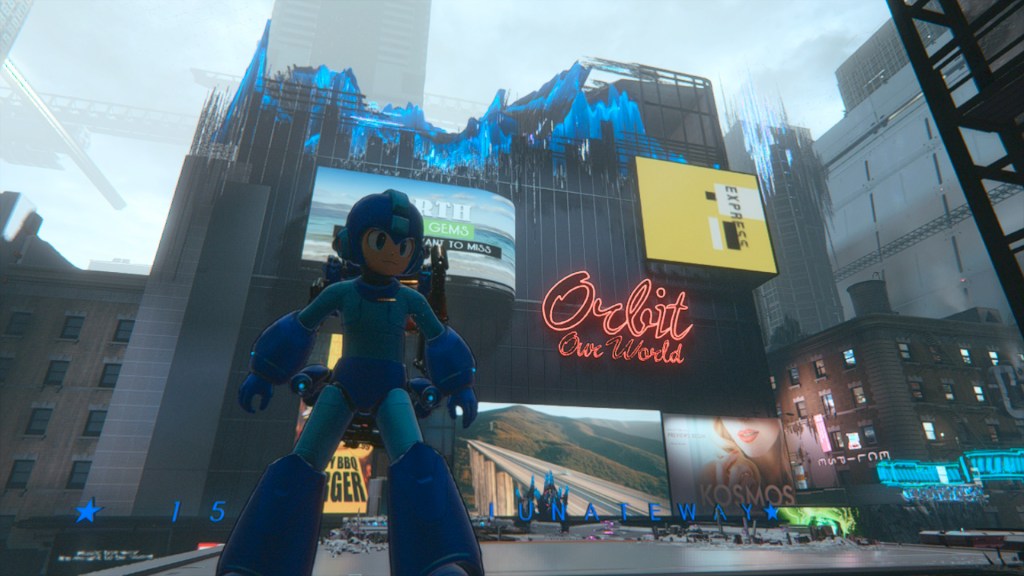
Yeah, Pragmata. Totally jumped back in because of the “Mega Man Mode” suit. So rad. And empowering! I love that Capcom just owned that they’re not hiding from Mega Man influence in the making of Pragmata. That little new detail can make it feel like a fresh game, and I think it’s empowering me to continue to take on Lunatic difficulty. It’s tough, and requires a lock-in and focus, but I feel when I have the energy and engagement, I’m back in baby. Replaying a couple hours again confirmed too, that Pragmata is definitely still my game of the year. My only barrier to continuing is being too tired to play something in which I need to be my best to avoid, dodge, hack, and take out bots without taking too many hits. Lunatic difficulty feels like a 3-hit health bar at the most.
Because a new Kirby game was announced…
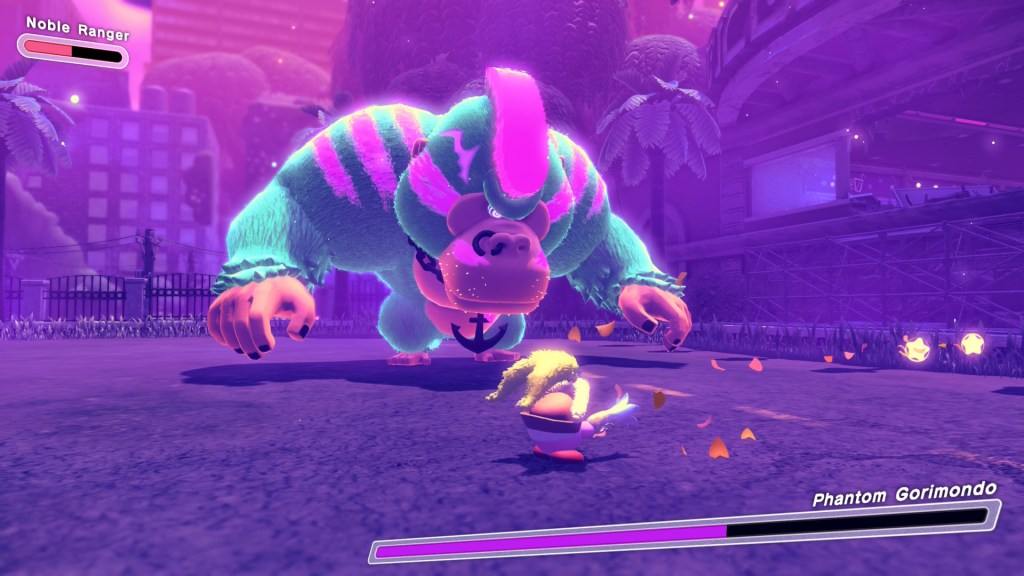
With the announcement of Kirby and the World Beyond, I thought it may finally be a time to revisit Kirby the Forgotten Land and play the Star-Crossed World DLC. I was curious too, having been the first Kirby game I finished this year which kicked off a big investigation of the franchise discography, if I’d have a deeper affinity for the game. I’ll say it’s very pretty. The movement is jaw-droppingly smooth. The moments of ‘this bit of platforming wasn’t there at all and now it’s magically there to interact with’ are certainly magical… but oddly enough I’m having a harder time connecting with this game. Could be combination of things. One guess could be that I already played it earlier this year, feels too close. But another, more educated guess, comes from my playing of more Kirby games and discovering that I really think the structure and simplicity of his games shine more in the 2D space. When I enter the 3D space of Forgotten Land, I feel my brain expects more. But it is basically a 2D linear Kirby game in a 3D space. I don’t think I’m done giving it chances, but I have booted it up and bounced off a few times now…
The one that’s been clicking the most…
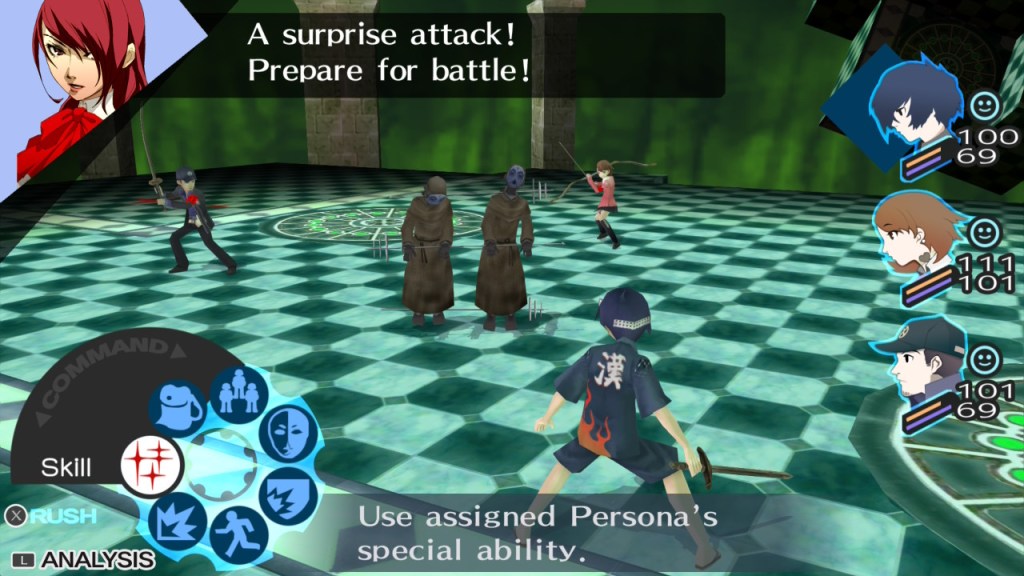
Persona 3 Portable. I’ll more than likely have more to say about this game in the future. I’ve been enjoying it. I enjoy the bare-bones nature of the Persona formula found here. Feels quick to get through events. Feels like an efficient game – it doesn’t waste your time if you don’t want to waste it. It feels good to role play and seek out time with characters I am interested in connecting with and learning more about, and avoiding characters I think are annoying. I know there’s inherent strategy to create certain builds / paths for your future but I desire to play it naturally, at least at first. I’d love to see where my natural choices lead me and what that means for the game’s story. Oh, and love the enemy character designs. From what I understand, the creator has been heavily inspired by surrealist art? I know that’s definitely more evident in Metaphor Refantasio.
So… what have I learned from all of this? A couple things. 1.) A chaotic life may require different needs from multiple games. Lots of changes and happenings this past week, and I had to use my game time to meet some mental and emotional needs (and I think I’ve regulated well!). 2.) Each week’s blog may see various formats. And I quite like this. Each week looks to document, contemplate, and reflect on game time spent. And to keep authenticity this week, I didn’t feel like pretending I was deeper into something than I actually was. This week it worked best for me to have a lot of little sessions with a big variety of games. I’m hoping what is true each week in regards to me playing video games will show up on the page each week within this blog 🙂
Cheers to that! Keep playing what you need to find joy in your life. 🙂
Your Friend Dillon


Leave a comment