
Persona 3 Portable
Where to start… Another video game franchise that is coveted and adored, one that I’ve yet to spend time in until now – the Persona series. I had caught the three most recent games in a Nintendo sale, $25 total. With the three games in front me and knowing that Persona 4 Revival drops next year, my plan of attack was to try 3 before I saw what the more critically acclaimed 4 and 5 were about. And I’ve gotten pretty into 3. Which, in my mind, is great! If I like what 3 is doing and it’s culturally viewed as lesser of an experience, then I want to let it be a foundation of my understanding of what a Persona game is and what it then can be. If I’m able to get through 3 with enough space before Persona 4 Revival comes out, I may try playing Persona 5 Royal in-between. That is, if I can make it through 3.
I still write in fear of jynxing these longer-game experiences. Truth be told, I’m too interested a wide variety of game experiences and opportunities to just play the same thing all the time. This past week, that did work for me – playing Persona 3 Portable exclusively – but I fear an approaching burnout after 21 hours played. What I have been learning over time though, is that taking a break from a game is different than bouncing off completely. Over the past few years, if I happened to get tired of playing a game at all, I’d think that meant that I needed to put it down completely. But often times I need to just give myself permission to take a break, let myself play other games, and give myself time to miss the experience before I jump back into it. I’m doing that right now with Final Fantasy VII Remake Intergrade. I’ve really enjoyed my time with that game but I needed a break from the game’s slower pace and structure. Time away gives your brain time to process the game, and potentially desire to play the game again. Or, other times, you fall off and that’s okay too. My point of thought here is to maybe let myself attempt to let my entrances and exits of games to be more natural and trust that I’m often chasing what I desire to play.
Anyway, Persona 3 Portable really worked this week.
I enjoy a game in which I can create my own narrative by making choices and following what I’m interested in. Persona 3 Portable‘s structure has you navigating spaces in the form of a top-down perspective menu. You move a cursor around to move about the spaces and either select locations and characters to engage with. The calendar system has you playing days and often choosing or experiencing one event in the morning, lunch time, after school, and during the evening. And of course, at night, you may go to the stacked floors of the Tartarus dungeon to fight Shadows. Shadows, by knowledge of your crew, are what are causing townfolk to develop the “Apathy” syndrome. You and your crew look to fight this evil with your various Personas in the dream-like, surrealism inspired dungeon world. All to prevent the worst from happening to your world.
I really love the game’s structure of school time and exploring events during the day – making connections with people – all having an impact of how strong your personas and battling can be overnight. The back and forth gameplay is very reliable and always gives you something dependable to look forward to. You know that you’ll enter a school day and receive narrative beats that may display folks gossiping, or a lecture in class, or a chat with one of your crewmates on the way into school. After school you often get the choice of what club you want to hang participate in, or other folks that you’d like to spend time with. Now, I know true Persona-heads have strategies of who you should talk to, when, and for how long, but I’ve sincerely been enjoying just following stories and characters I find interesting and want to spend game time talking to. If that means failure in the end, then that’s cool, and will be my natural path that reflects the way I played and the choices I made.
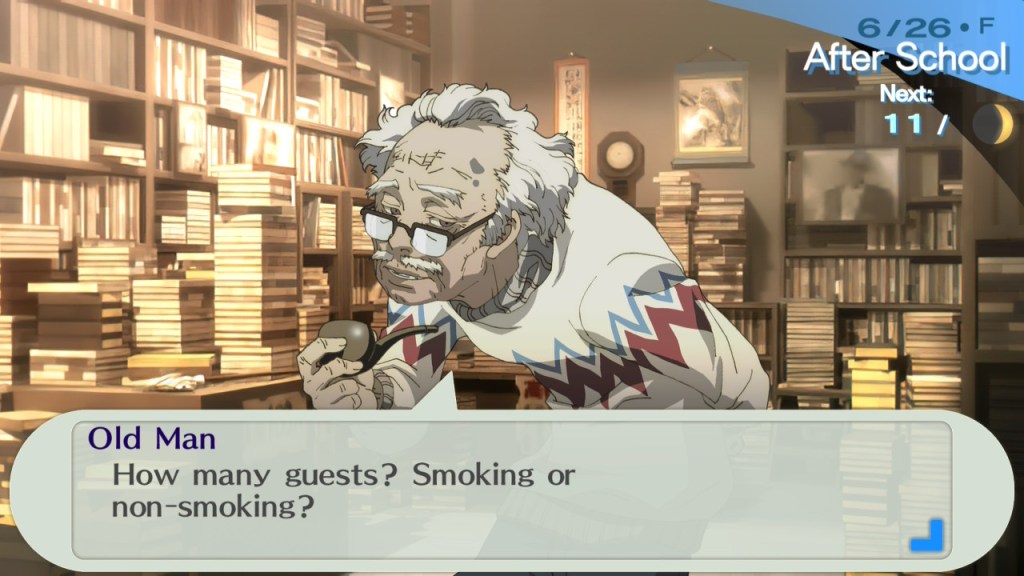
In regards to characters, I’ve spent a decent amount of time with Kazushi, your swim team teammate if you choose to participate, and followed a story for a while of why he continues to push through a bad knee to keep training. Eventually, I got nervous that I was enabling him. I’ve spent a decent amount of time hanging out with Yuko and she is my character’s main romance option at the moment. And most recently, I’ve enjoyed spending time talking with the old couple that runs the book shop in the strip mall. They’re often just thankful for my company and that makes my heart happy. The sense of role-playing character by naturally connecting with characters builds an experience that feels exclusively yours and I think it’s a factor that definitely keeps this game attractive.
Let’s not forget about Elizabeth too. She’s a different character in that she exists in a strange realm behind a mysterious blue door that holds information and tasks regarding your work with your personas. But she has tasks that she desires to have completed for reward, and often, some of those tasks require you to take her on a date in your world. You take her to various locations and its charming how she views mundane things with otherworldly eyes. She’s warned by mall staff to stop riding the escalators too much, she throws wayyyyy too much money into the wishing fountain, and has more interest in drainage covers than most humans. It’s fun writing, and an objective I often choose from her list just to see what happens.
There’s some I’ve avoided too. I find Kenshi to be desperate and annoying – too eager to want to hang out. With a variety of locations to go to and people to connect with, it’s clear that you can’t do everything every day.. or that you can’t keep up with everything. And therefore the game encourages you to choose. Gives you autonomy. And in regards to connecting to the story you’re building, that feels very good.
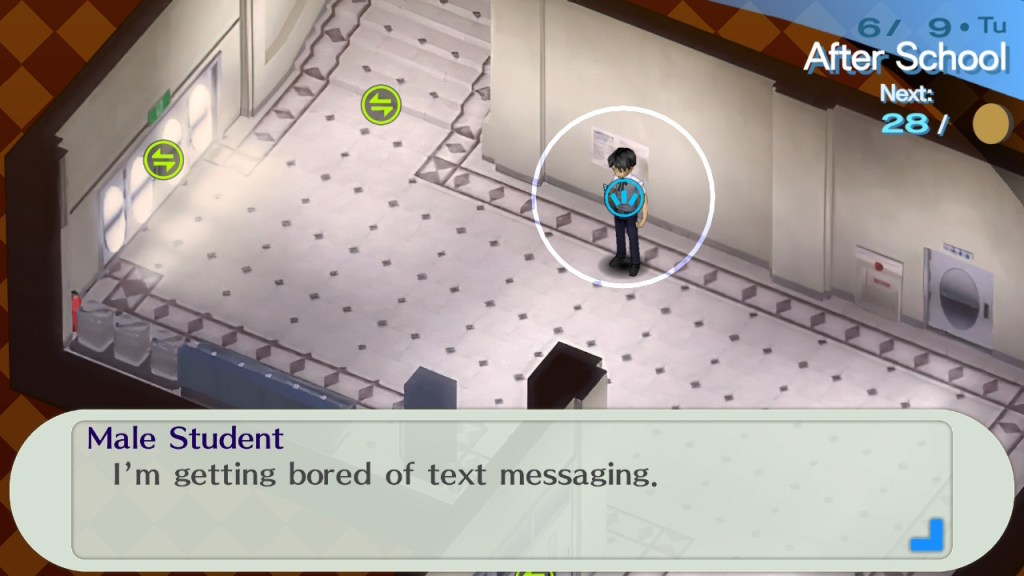
I took note and compared relationship feelings in this game vs. my recent playing of Fields of Mistria. A GIANT difference I have found here is that it feels like all of these characters are into you too. And that’s good for a more introverted person. It can bum me out that all of Fields of Mistria‘s characters would just live their lives with or without your existence, though I understand that’s the style and tradition of the genre. The game makes it your job to impress them with the right gifts, and if not, you’re not good enough. In Persona 3 Portable, you’re already an active part of the world. Characters prompt to hang out with you. Relationships in the game are not entirely your responsibility to keep alive.
Persona 3 Portable fits into my life well because it’s a very easy peck-at-it game. It has small increments of continuous progression that make it easy to put down and pick back up at any time. It doesn’t feel like a game that requires you to have momentum with it before you start playing, or having to maintain momentum/energy while playing it. You’d think the dialog would get old, but it’s fast. It’s very clickable. The story and writing are efficient and nothing drags on – it all moves along swiftly. And playing with the voice acting in Japanese is a note I may take into future voice-acted RPGs: when they’re speaking Japanese – a language I can’t say I understand – I can quickly read the words in English and skip to the next line when I’m done reading it. When I do that and disrupt an audible voice-acted performance in English, it can kill the magic. It doesn’t feel like a disruption to interrupt a language I don’t understand, and I play games at low volume most days anyway.
In regards to battling in Tartarus, I find the enemy designs to be really fun to look at. They certainly feel inspired by surrealism and I know director of Metaphor ReFantazio Katsura Hashino (also known for their work on the Persona series) drew heavy inspiration for enemy design from surrealist paintings in that game. The same appears to be true in Persona 3 Portable. The “Trance Twins” look like something I would have drawn in high school (and would still enjoy to draw today). The enemies all appear otherworldly. They’re more cool looking than they are frustrating or intimidating, and it makes the repetition of revisiting the dungeon nightly for a similar, grindy battle experience enjoyable… and I never say that grinding is enjoyable.
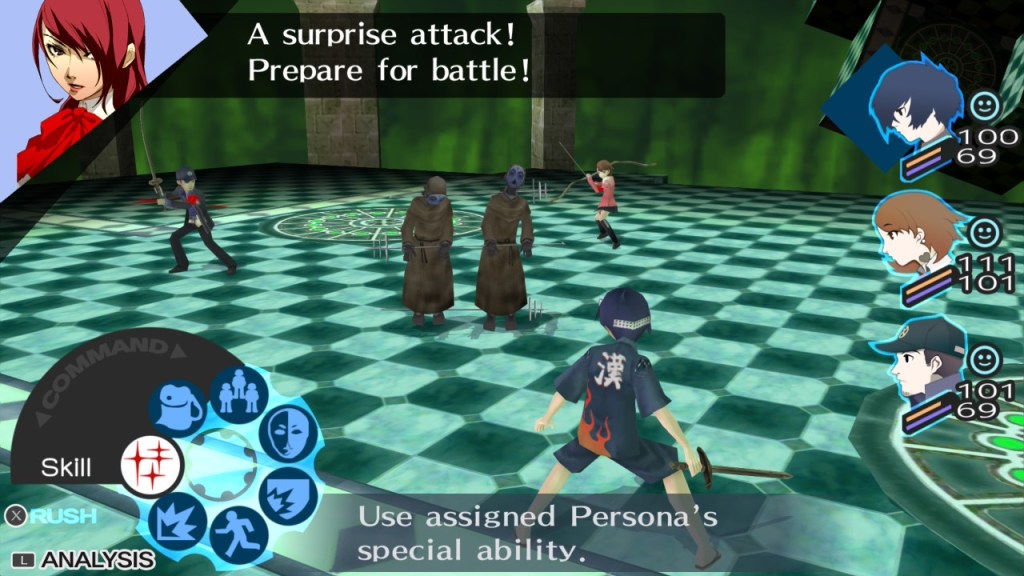
Also, in battling, I appreciate that you only have to control your character, and that your party members are actually helpful. Though, I did encounter a boss fight in which I wanted them to perform certain behaviors and it turns out the game will let you go into full control mode if you want to. Or, you can choose a couple characters to control. Or you can set tendencies of their actions/tactics. The player trust the game gives you to play battles the way you want to is great. You can even auto-battle fast forward through them if you’re confident you’ll make it out healthy. I’ve been thankful too that “you can retry this battle.” I haven’t come across one I can’t retry – even boss battles – and they allow you to keep the damage you’d already placed on enemies. Not a complete redo.
I was curious if the dungeon Tartarus was endless when I started playing – there are certainly a lot of floors. But they’re small and again, that small incremental structure of beat two hoards, gather an item, go upstairs, is what keeps you playing. If a dungeon at all felt too big of a task, I’d be more likely to bounce off. And it feels like the developers knew that, and structured a game that keeps you playing by allowing you to keep progressing in small ways very often.
As you continue to battle and progress, you unlock different personas you may use to attack in battle. Each persona has various attacks, some of them with different types of attacks that certain enemies are weak to (Pokemon style). It feels really good to obtain a persona that has an attack type you didn’t have before. And like Pokemon, this game values matchup types. A standard attack from my level 19 persona won’t do much in comparison to a freeze-type attack my level 13 persona can pull off if the opponent is weak to it. Feels good too, when all the opponents you are facing are knocked down, a prompt asks you if desire to gang up on them. If yes (you should click yes), you and your team pile on comic-book style accompanied by various onomatopieia and punching sounds. Very fun, and a lot lighter than I expected.
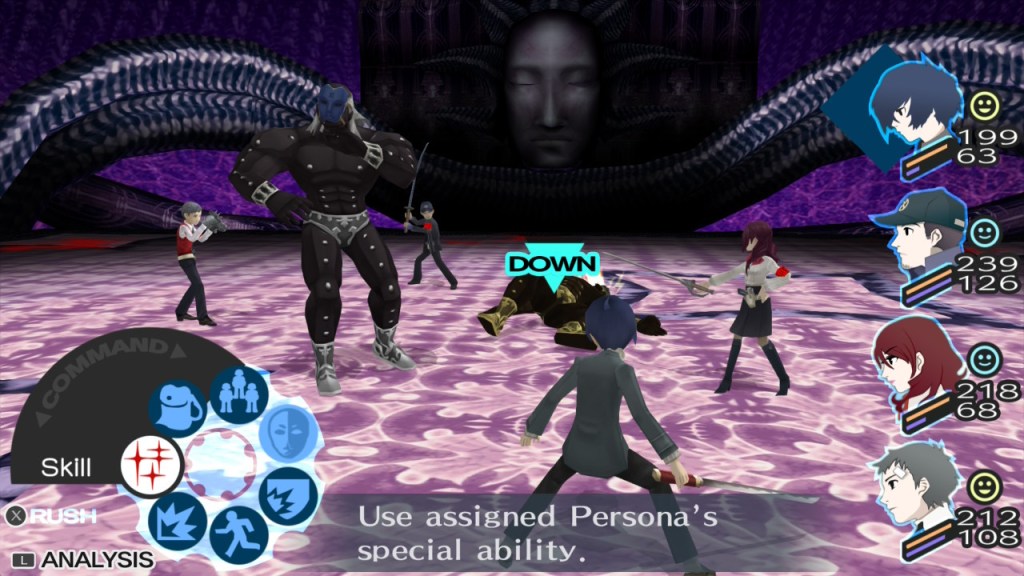
I have to shoutout the style of this game too. Very Dreamcast. Very early 2000s. I would have loved the look of this game if I played it when it came out (though, I certainly wouldn’t have been into the gameplay then). Like I mentioned earlier, enemies look like characters I love to draw. The main character’s hair was GOALS for my hair in highschool (my hair’s too naturally wavy). Even the emo look and demeanor. The main character’s celebratory sword swipe followed by a hand-in-the-pocket shoe-gaze. It’s rad, and I’m happy to be spending time with it.
Persona 3 Portable is tough to write about and explain to someone who hasn’t played the game. The basic premise I’d heard before entering is that what you choose to do and who you choose to interact with during the day directly impacts your overall stats and how you can perform during battles at night. Everything in-between is an engaging role-playing experience as a high-schooler with a limited group of folks that also hold the power to fight Shadows at night. The goal being to keep evil in its own world and prevent it from causing catastrophie in yours. But the experience you have in-between is yours. The choices you make and the characters you interact with are yours. It feels like there isn’t one way to play it, and it’d be fun to have conversations with folks that all have completed playthroughs.
I hope this won’t be the last I write about this game. I keep seeing a very positive reception to TOEM 2. There’s no doubt I’ll want to pick that up and play. But as of right now, the interest in Persona 3 Portable remains. We’ll see if I can reach the top of Tartarus and pass all my exams.
Catch you next time. Thank you for reading 🙂
Your Friend Dillon


Leave a Reply