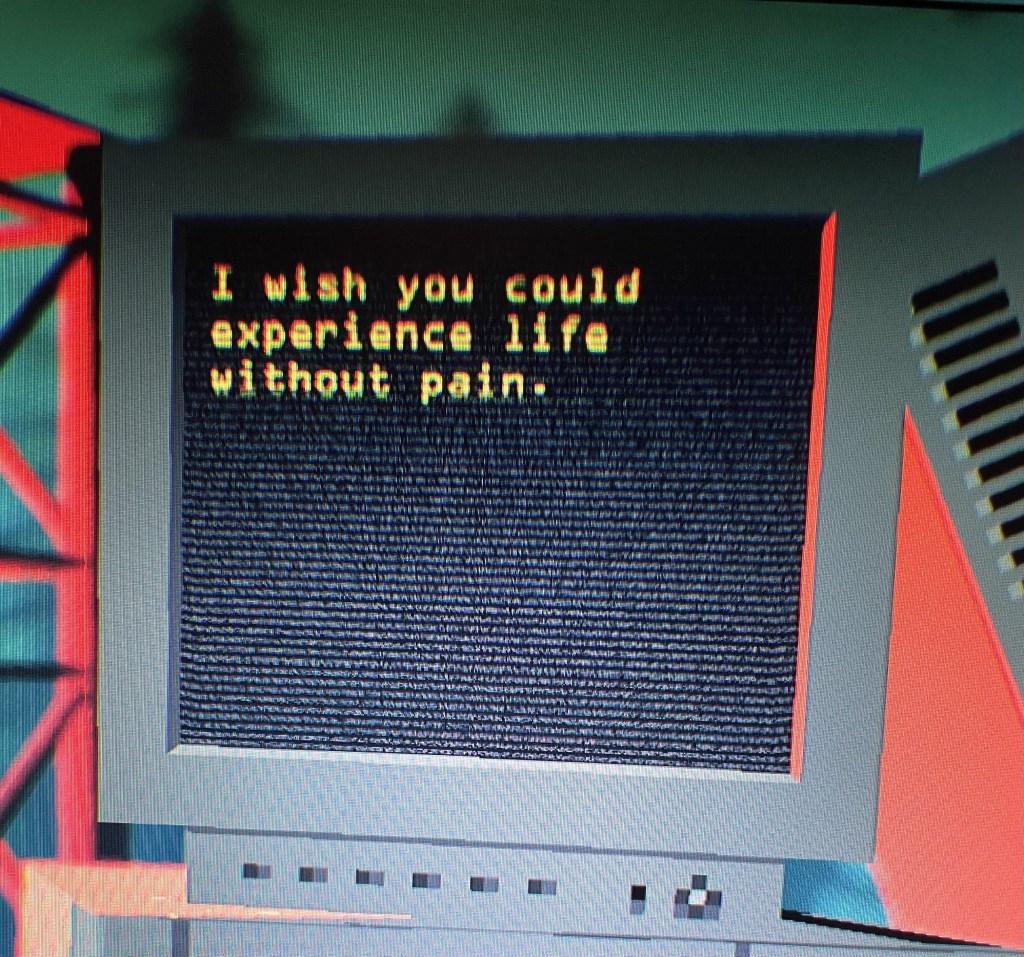
Y’all… we gotta talk about this. Or at least I do. I just played through Virtue and a Sledgehammer and have been completed impacted by the experience. It happened how a lot of my favorite video game experiences happen, where it wasn’t completely on my radar, it quickly entered my radar at a time that felt perfect to play it (thank you Girl Mode podcast), I ripped through it and it will now stay with me forever.
Virtue and a Sledgehammer is one of those games that feels impossible to talk about without spoiling, so up top here, I’ll say, go play it. It’s shorter. It’s emotional. It’s impactful. It’s VERY relevant to today’s AI push. I’ll also say, that I strongly desire to talk about/write about my experience, so I’ll be doing so this time around with *SPOILERS ON.*
I encourage you to check out the game and come back to this post if/when you’ve played it. If you’re merely curious and don’t care about it being spoiled. Read on. Either way, thanks for being here 🙂
Virtue and a Sledgehammer
This game is 100% 1000xRESIST coated. It holds the same presentation of game in which you navigate cutscenes by clicking the next line of dialogue, and most times you do, you’re gifted a new camera angle that creates a cinematic, emotional, and impactful experience. It’s not as long as 1000xRESIST, thankfully, but packs a punch and tells a great, efficient story in the time you put into playing. Willa Rowe of Girl Mode podcast praised Virtue and a Sledgehammer for ‘…showing us that games can be short, I mean, what are we doing!?’ And I agree. Virtue and a Sledgehammer and games with similar structure that a powerful and lasting experience can come in a small, achievable package. I didn’t need to log over 60 hours here (I’m aware 1000xResist wasn’t that long but you get my point).
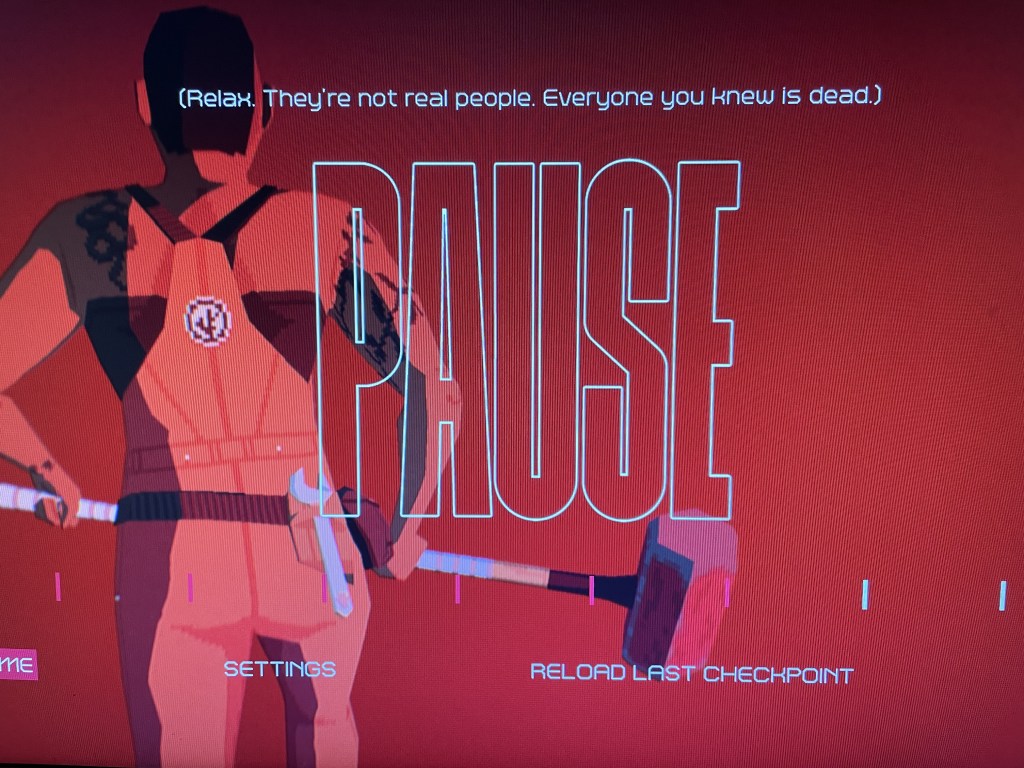
From the jump, the game has excellent graphic design. The fonts used read contemporary and digital. The pause screen proves that every moment of the game can be artfully framed. The tone of the game communicated early with a “Relax. They’re not real people. Everyone you knew is dead.” And the only simple, efficient tutorial given to the player uses that lovely graphic design encouraging you to ‘hold R2 to deal with your pent-up rage.’
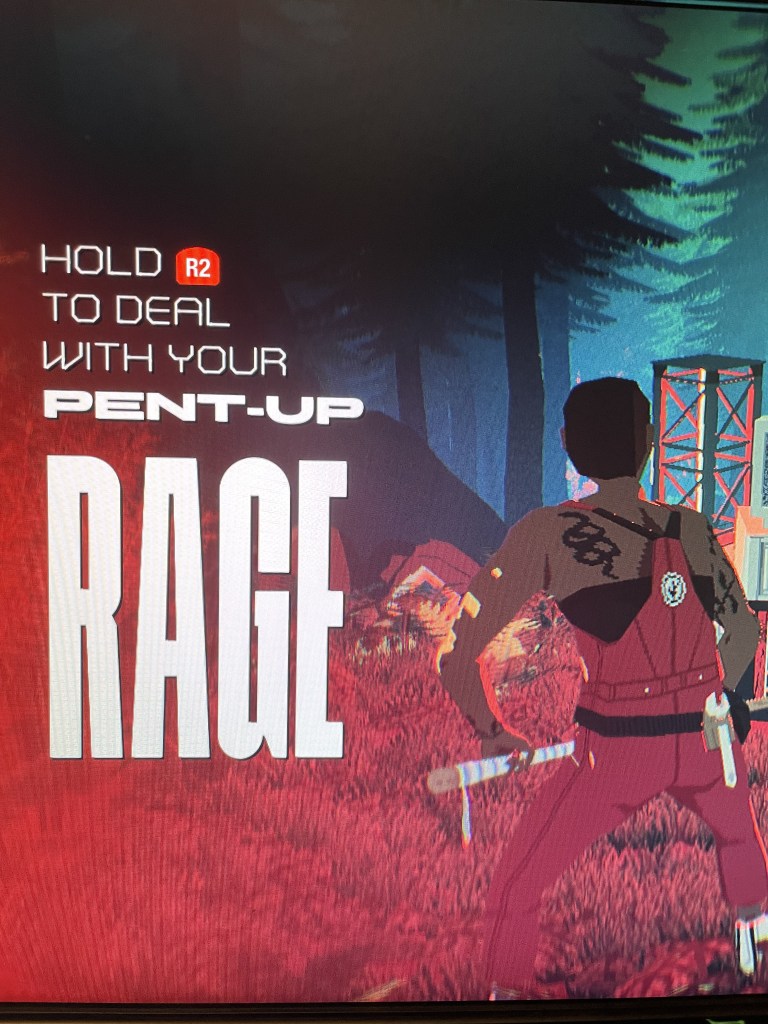
As I began to swing the hammer and realize the mechanic in place, I quickly noted that it purposefully feels like it could never be enough. The physicality of the sledgehammer is not satisfying, but rather a trying and frustrating attempt at violence backed with rage and oppression. The swing has a build-up, it takes time. And it’s strongest, over-the-head swing takes the most time. So you’re not then blasting through walls and robots in a way that feels good necessarily, but in a way that feels raw, that feels human, that feels tired. I love the metaphor though – the use of a very human tool. A tool meant to be an extension of human strength. Nothing automated. Not a gun. A tool first made by human hands.
Metaphor also lies within your navigating of the space. In order to progress, you have to think and break through establishments. Houses, walls, fences, computer towers… all in your way and they all take that painful swing of the hammer to smash down and through – at least one swing, sometimes more. This physicality easily communicates frustration. The need to fight for understanding. The need to break down and fight against these various conventions, new and old.
Robots
So the premise of the game is that your sister is an Elon Musk-type – one that believes the greatest form of existence lies beyond our human existence and is better transcended or “digitized” into a physical robot form. Or, I’m sorry, she’d rather you call them “digital humans.”
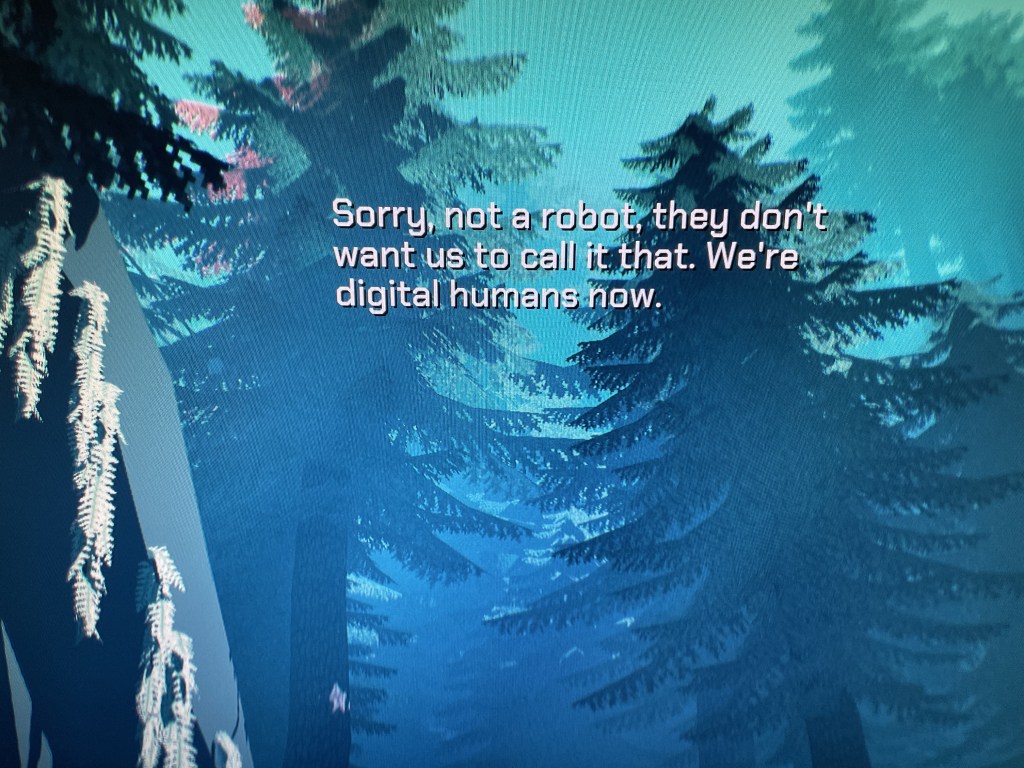
And she’s transformed the town and everyone you’ve known into transcended robots. The message of the game strongly persuades you to forget any trace of humanity, and that these robots are not human. But what the game does beautifully is tugs at our natural empathy. It was interesting how many times I spared a robot that claimed their life is ‘better’ this way. Or how I spared many robots that were non-threatening. I’m curious of what the devs would think about that play – my guess is that it further drives home their message. I consistently felt tricked into trusting the human nature of language used by the robots and connected to them more than the game’s message wanted me to? I don’t feel bad about the way I played, because I think my natural response to the game they made is all part of their commentary, and as I’ll write about my first ending later, my given trust came to bite me in the end.
The game asks you to question morality quite a bit. The game asks you to think about what it would mean to have a human consciousness transcended into a robot body. They pull at your empathy by what they claim to feel. But the game also comments on how that notion is just an echo or imprint of who those people were as humans. The game places value on human pain in a way that I really needed. It validates the human struggle in a society that has plenty of solutions for your pain with the right price and sacrifice. Virtue and a Sledgehammer exposes the lie of contemporary convenience, and how human pain is necessary for human growth. AI benefits from humans trying to avoid their pain through convenience.
The Steam achievements you obtain throughout your play provide additional commentary that goes directly to the player. It’s nice. It feels like the main character and storyteller is speaking directly to you after re-witnessing the events of their past together. Some were a bit longer than the small rectangle in the bottom right corner of the screen. I’d like to take time to read all of them. It feels like these may have been parts of the story that were either really well written, or rooted in true happenings – perhaps both. An early example of this achievement commentary made an impact with one I unlocked titled “Stay Sweet.” The lines underneath read “No one liked it when I started getting smart.”
More impactful moments
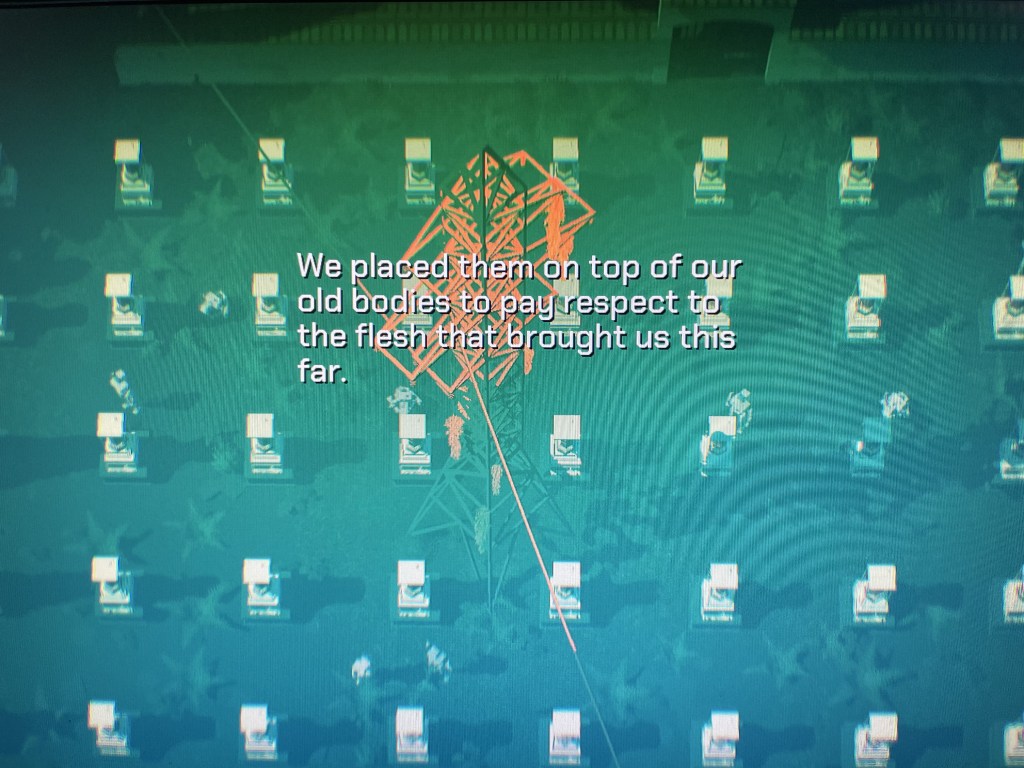
This quote hit me like a brick. ‘We placed servers on top of our bodies to pay respect to the flesh that brought us here.’ This was the first time that the ideology of post-human had really struck me in-game and scared me to know that there are people in our world that believe this is the better way. The game presents a society that believes or has been brainwashed to believe that Nina (your sister) has saved them. That their lives are better this way. That being human was an inconvenience and this robotic form is ideal.
It’s funny, I’ve found a giant shift in my perception of science-fiction as of late. I used to think the implementation of androids, droids, robots, and non-human life forms into our worlds and societies was interesting (Detroit: Become Human, iRobot, Cyberpunk 2077…) Interesting with the luxury of thinking, ‘that’s completely imaginative and there’s no way that will ever happen.’ I’m now perceiving the content as a warning, and I’m scared. Virtue and a Sledgehammer shows you what it would look like to be transcended.
There’s an interlude where you’re put into a first-person perspective of a gentleman on a table being questioned by Nina. She’s asking you questions to measure your brainwaves for the accuracy of your transfer and encourages you to answer honestly. The first-person perspective here was really impactful. Being assumably strapped to a table and transferred feels scary – it feels like death. After the series of questions she asks you to count backwards from 500, implying you’re about to go under. You get to 496 and the screen goes black.
White text enters the screen and encourages you to stretch out your new legs. You get to be the robot now.
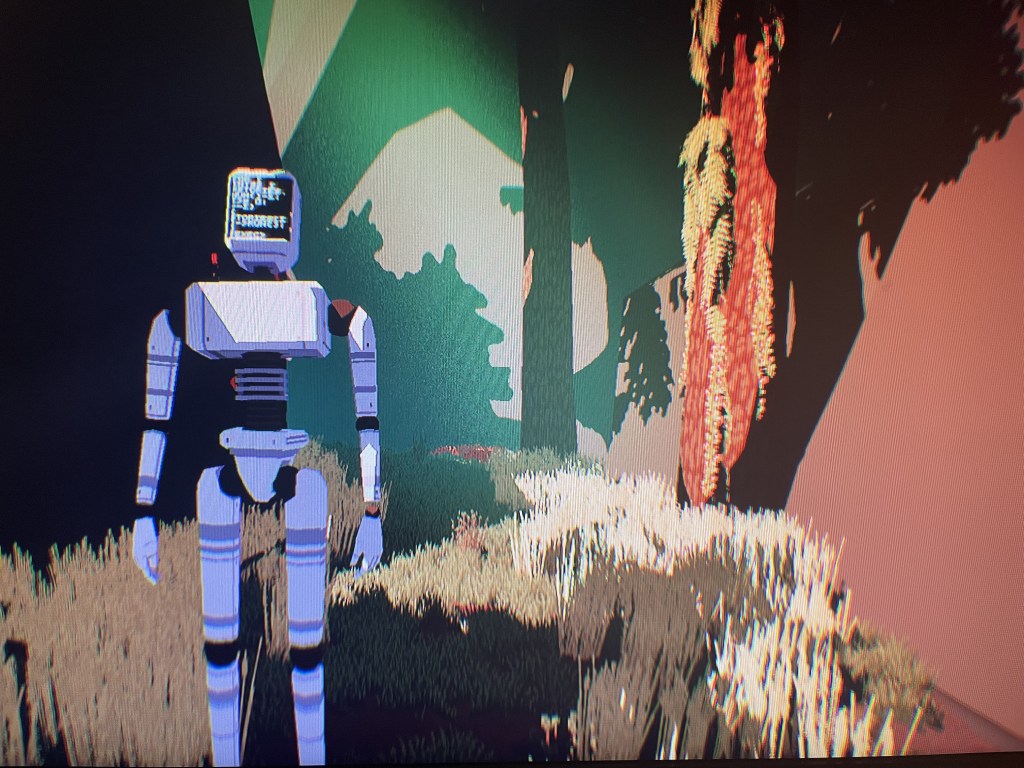
Super impactful. Giving you the chance to be the robot in a beautiful nature walk is not at all encouraging – it’s sad. I could feel the disconnect. I could feel the lack of feeling. Which is interesting, because I was playing a video game, which is another crazy layer to the conversation… but… I feel the point of that scenario was for you to feel claustrophobic in a fake bodysuit. To feel that your senses are now void and you’re just a consciousness walking around nature without the ability to take it all in. You’re prompted to walk to the top of the hill to greet your wife. I did not expect to get smacked with the feeling that comes after. As soon as I crested the hill, I found another robot sitting on a bench.
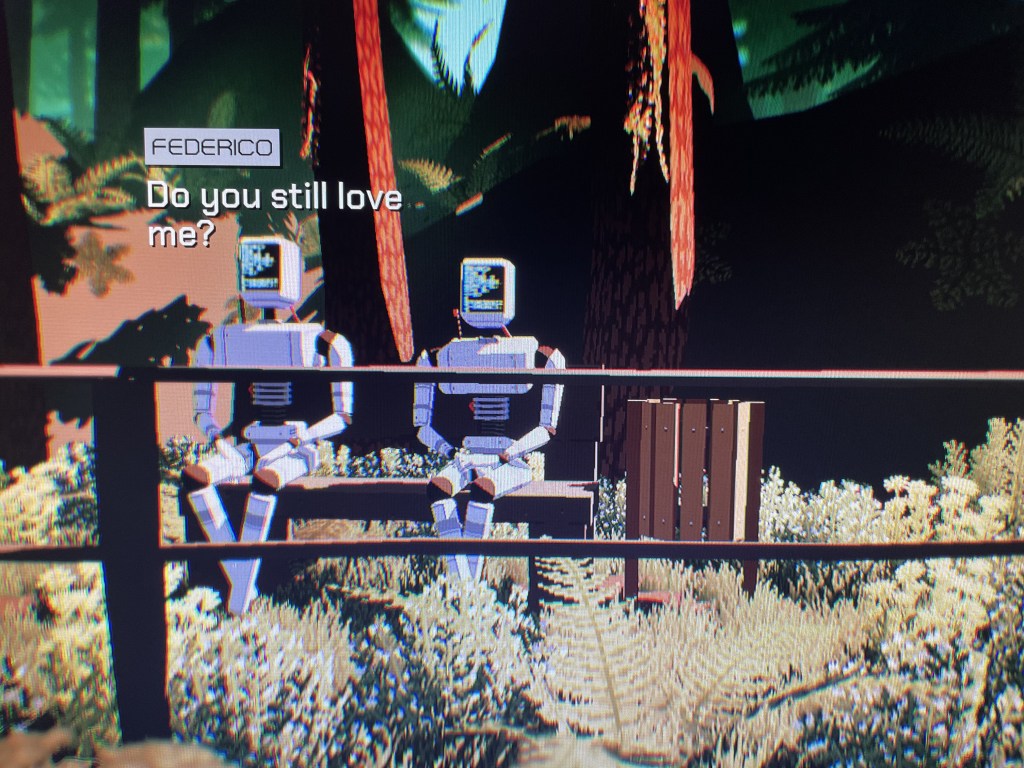
This made me think of my own life, and my own wife. Again, that fear of what could be. I felt tears start to head toward my eyes. To think of my wife, too, being transcended into a robot. The life that we have together, now gone, and transformed into something else. Something less. Frederico, the character you’re role-playing as in this interlude asks his wife, “Do you still love me?” What I heard instead was, ‘Is our relationship still the same? Are you still you? Did we make a mistake?’ So gut-wrenching and sad. Note, too, that earlier in the game, I’m pretty sure you were asked by Frederico’s robot to find his family in their house at the top of the hill and kill them all. Or in a sense, free them. He cries that they’re all trapped in a prison. I spared them, as the kids acted scared upon my invasion… but that’s the continual the game asks you to contemplate – does this simulated human emotion being expressed from this robot feel real to you? The game tries to continually remind you that they’re all dead anyway.
Back to the graveyard. The ‘honoring’ of flesh placing servers on top of graves. What a wild visual. Of course you’re encouraged to smash them. Another wave of emotion smacked me here – each time you smash a server above a grave, a real picture of real people flashes on the screen. Slightly glitched, but REAL pictures. Not pictures of people in the video game’s style. Real people. I then questioned, ‘Am I freeing them?’ ‘Am I freeing their souls?’ What a beautiful question to ask in this moment. This felt like smashing that Pratelle (the main character) would be doing through tears. It felt the most like grieving. It felt the closest you had been to the actual, human people that used to be.
The game I didn’t know I needed
It was empowering to smash through AI bullshit. Virtue and a Sledgehammer is at the very least a good outlet for that, but as I’ve already written, it’s so much more. It was empowering to think, and the game states this too, that a machine, too, would eventually rot and decay. One ending of the game expresses that all things are meant to die. That the universe needs to cleanse so that new can be born and that it may continue – and the game looks to celebrate the beauty of that. That the goal shouldn’t be to defy death but understand that pain and decay is a part of the human experience.
You come across one particular robot that offers a cutscene. These characters are periodically placed to tell a human story from the robots perspective. What’s pretty amazing is that, if you’d like, you can interrupt them at any time by holding R2 and smash them. I listened though. For the pure curiosity of seeing what the game wanted to say in these moments. But this particular robot had been thinking, and states to you in the context of the work they used to do at a sawmill, ‘I used to hate the work I did there but now I kind of miss it.’ “I’m finding myself missing stuff that I considered negative back when I was flesh and bones.” It got me thinking of my own career, my art teaching career, that has been nothing short of difficult. I’ve often thought of leaving it, finding something easier to do with my days. But now (and by the time this writing is published, I’ll know…) it’s being threatened to be taken from me and I’ve continued to process that in this blog space (thank you). If our local levy doesn’t pass, my program will be cut. But this instance in game shows what it could look like after, and just because work can be difficult and painful doesn’t mean it’s not worth it. It’s complicated, but we will see what happens…
What led me to my first ending
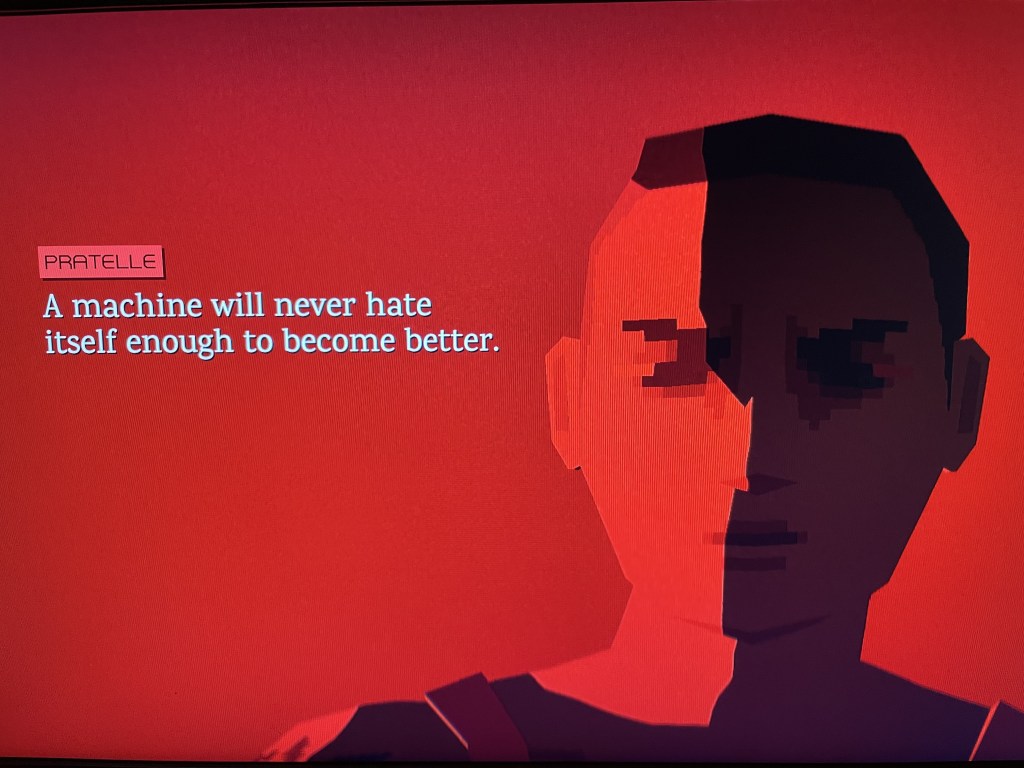
Throughout the game as you navigate spaces, you find glowing red figures made of glass inviting you to smash them. When you do, a red-backgrounded screen appears with quick, striking imagery that tells visual snippets of the story/trauma had leading up to these moments. When you collect/smash enough of these glass red figures, you gather a cutscene that shows you a snippet of your past. You find that you and your sister Nina really struggled with your mother. Your mother had suffered abuse in her upbringing and now you two do. She finds you both spoiled for having more opportunities than she had, and resents you for it.
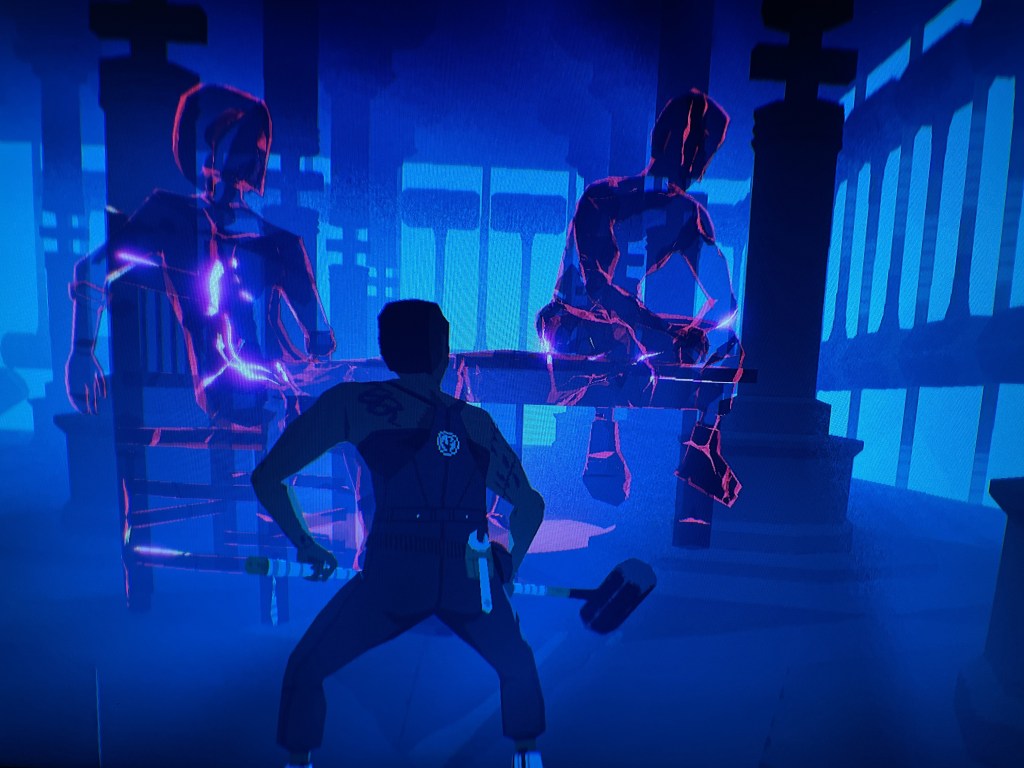
It’s also implied that she begins to witness some sort of dementia or Alzheimer’s. Pratelle especially struggles with how “impossible” she can be. These bits of trauma growing up mixed with Nina off to uni create the idea in her head that she can fix it all – that she can give her mother a life away from her failing body. However intense the various trauma’s were, what the game strongly communicates is that Pratelle and Nina experienced them together.
Long story short, you make your way to Nina. You make a long, painful but beautiful trek up a mountain at sunset. A powerful and emotional song plays. No robots or objects get in your way here, just time, space, and terrain as you make your way up the peak. You have an idea of what you’ll find at this point, hinted by other characters – a note that ‘of course Nina would build her final resting place at the peak of the tallest mountain.’ Ego.
You come then to find a super computer. A hollowed circle of networked servers connected to various power lines and towers. Call it a data center. The circle frames a human torso at it’s tip, and we find who we expect to be there – Nina. You enter with frustration and she guilts you for your barbaric actions. She’s even kept count of how many robots you’ve destroyed.
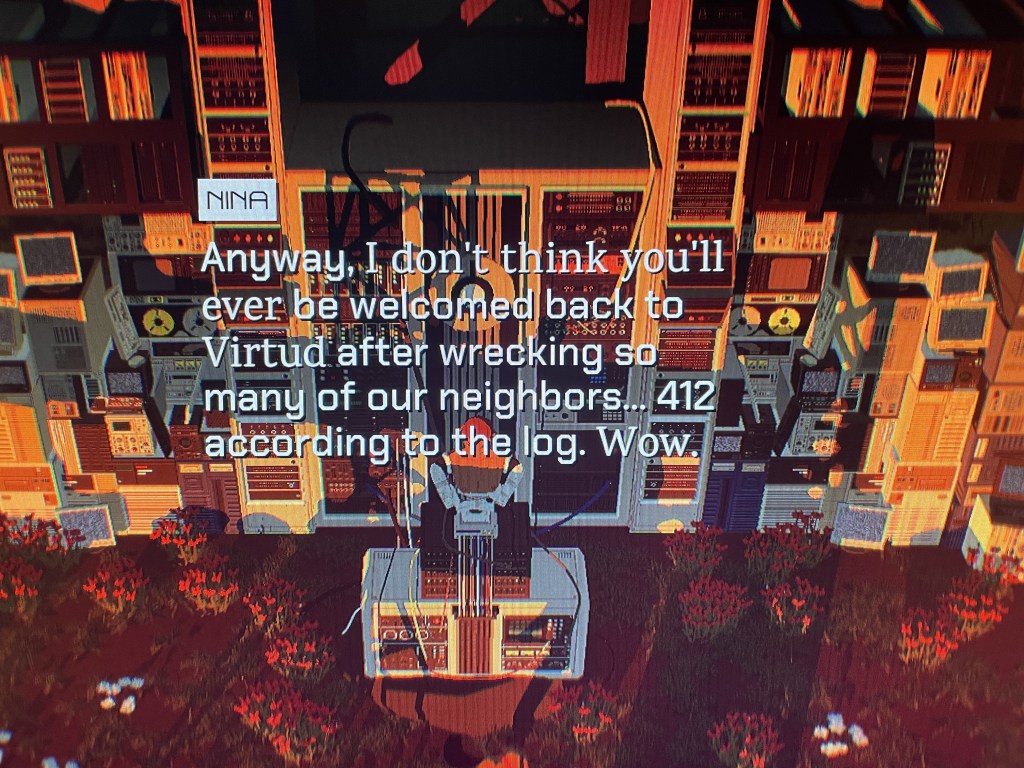
Here’s what grabbed me. She admits Pratelle was right. She admits that something is lost when you transcend a human consciousness into a robot body. She admits it’s something she aims to fix, but an apology hits hard. With that, you then get the option to embrace her & hug her, or reject her and smash her. My choice to embrace her was out of curiosity and from what I read of Pratelle. That these strong memories of the past are with her, and I was curious what would happen if I chose love.
The game then begins to replay those times together, those traumas, or simply those times spent carving your names into a tree. Your times being sisters. That, juxtaposed with Nina stating her current context. You’ve spent all this time smashing through what is left in the present, and working through memories of your sister. Now you are with her in real-time and she admits how complicated this all is. It feels like a full circle moment. She begins asking you questions relevant to those times with your difficult mother. You’re given choices to answer. She then asks more questions, and it took me until the third one of those more questions to realize what was going on…
The questions she begins asking you are the same questions she asked Frederico during the interlude when he was being transferred. I had believed she was genuine until the screen showed me as Pratelle in a first-person view with this new Nina leaning over me. I’d been tricked. She was transferring me. The last thing she asks you to do is count backwards from 500. I very quickly realized it was too late. The title appears large on screen and the credits roll.
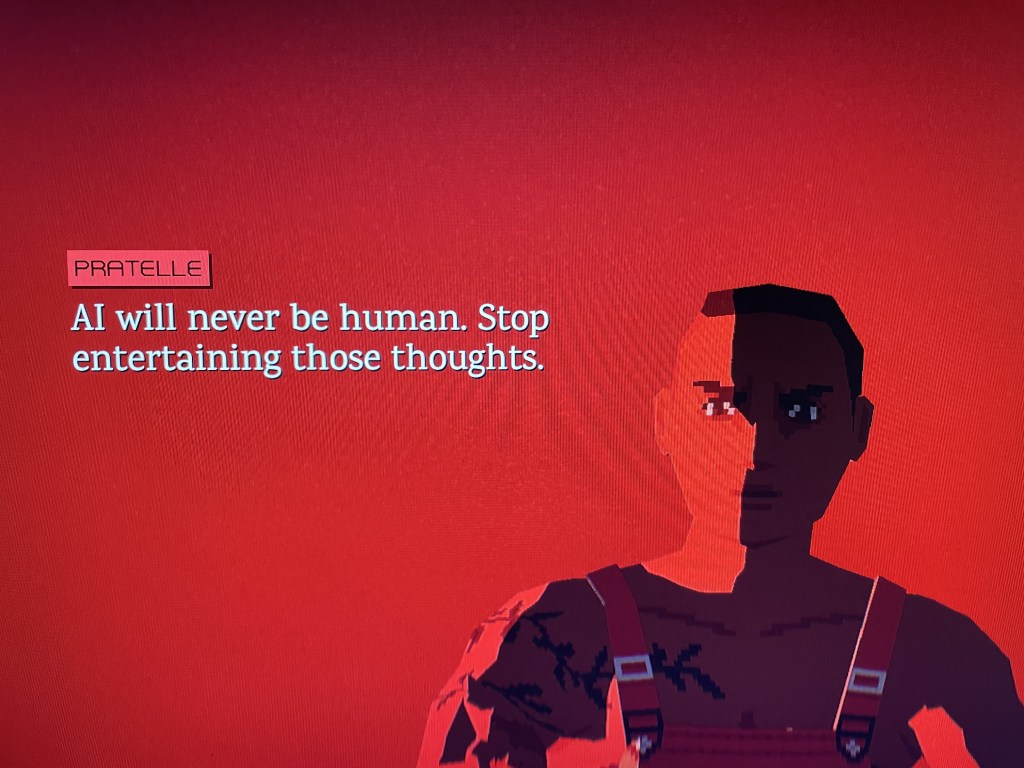
What was communicated to me here is that I trusted the human side of all of this too much. That I was manipulated. And that if I give an ounce of trust to AI, it will use it to manipulate. It scared me, and it should. Nina betrayed me, and the game tried telling me she always would. But the game also provided that very human side of things – the emotion, connection, the trust.. however simulated. A very impactful ending that really sends their message (below):
After credits, I was happy to find that the option to ‘RESUME’ still existed on the title screen. Of course I clicked it. A new cutscene arrives asking if you ‘really want to contemplate a different future?’ ‘You can’t just let it be what it is?’ ‘You could be doing something more beautiful and important right now.’ Yes, I’m sure. This guilting of gamers for playing your game is getting a tad cliche in this space if I’m honest (yes, you, Titanium Court), but I pressed on and was VERY thankful to see you placed then back at the moment right before you confront Nina at the top of the mountain. You then may choose the opposite option, or at least I was able to having chosen “Embrace” first.
Thank you Virtue and a Sledgehammer
I, like a lot of people and clearly the developers of this game, have had a hard time in 2026 with this major push for AI. Outside of video game blogging, I am an Art Teacher and art maker. The push for implementation of AI into pop culture sickens me. I’ve watched TV a whole lot less. I continue to attempt to remove myself from sources of it and it feels inescapable. It’s directly affecting my job. Society under AI has no use for artists and creatives, so folks that agree with that (the state of Ohio that I live in) don’t believe it is important to have Art in schools. AI is a threat to the core of what I believe in – human creativity.
It felt good to smash it here. But like I said, it still doesn’t feel like it’s enough and the game knows it can’t be. But to have those feelings validated and understood felt great. The presentation of this game made me feel like some folks are on my side, and I’m not alone. I may be losing my job soon, but projects like this encourage me to keep my soul – to keep art within me – no matter what my occupation is.
Stay creative. Stay human.
Your Friend Dillon


Leave a Reply